A research paper by Ulrike Ortrere from ArtEquestre
Since antiquity southern Italy had possessed an important tradition of horse breeding. Both breeding and training of horses and riders were shaped by the requirements of warfare.[1]
The medieval horseman fought with the heavy, rigid seat of the à la brida, also known as ghisa. His horse was expected to move powerfully in a straight line and to break through the enemy ranks with force. The rider’s leg was held firmly extended in order to absorb the impact. Alongside this existed the lighter practical riding style of the gineta, with bent knees and a more mobile seat.
Warfare underwent, however, a decisive turning point when the Ottomans captured Constantinople in 1453 with the help of cannons.
From then on, artillery increasingly replaced the armored knight. Soaring use of pikes added to this and made the massive warhorse more and more obsolete. Swords and, from about 1547 onwards,[2] the wheellock pistol came to dominate the battlefield. Skirmishing emerged. This type of combat needed, however, a different type of horse: a horse that could sprint, turn, and remain balanced in confined spaces. In equestrian terms, it needed the ability to perform a career, a hindquarter turn and a volte.
Naples was to become the starting point for this new Equestrian Art in Europe. For the Ottomans first threatened its Aragonese rulers. And these urgently sought to solve the problem on their doorstep…
From Byzantium to Naples
Two Aragonese figures — Spaniards, from today’s perspective — became decisive in this development: Alfonso of Aragon (1396–1458) and above all his illegitimate son Ferrante (1423/24–1494), rulers of Naples from 1442 onwards.
For their purposes, they adopted and transformed an ancient Central Asian riding tradition and its associated type of horse.
The inspiration for this may have come from the wider context of the Council of Ferrara and Florence (1438–1439). There, the Byzantines attended with a spectacular delegation headed by Emperor John VIII Palaiologos.[3] Whether the Aragonese saw them personally is questionable.[4] The Byzantines, however, certainly left their mark on the courts of Ferrara and Florence. The Este of Ferrara in particular were dynastically close to Naples.[5] From the time his father ascended the throne, Ferrante even grew up alongside their heirs, Ercole and Sigismondo, in Naples.[6] Alfonso arranged there the military and equestrian training for the three. A riding instructor—or simply a gifted rider—may have accompanied the Este and have told the tale.
Another – more likely – source of inspiration may have been the Greek and Albanian Stradioti, Byzantine mercenaries, fighting in the service of King Alfonso. We know, for example, that the Stradiot leader Vrana Konti (Brana Conte) had served in Alfonso’s army even before the latter ascended the throne of Naples in 1442. [7]
Above all, the Tzykanion, the Byzantine ball game played on horseback, may have served as a tool for transmission over the centuries. It employed a riding style geared towards agility, balance and rapid changes of direction. For this purpose, the Hittite-Median Nisean horse, [8] which was at the time usually trained by Persians, may have been preserved in Byzantium. That it was indeed the Nisean horse praised in numerous ancient sources[9] is suggested by a recent genetic study.[10] In fact, there appear to be no other candidates.[11]
Through the Aragonese and their close relatives in Ferrara and Mantua, it was not only the horses that were imported. The ancient (close-combat) riding style described as early as Xenophon’s Peri Hippikē was used and transformed as well. Around Naples, the Equestrian Art based on it was subsequently enhanced to include parade riding lessons. The High School was created, the adjective ‘high’ referring to the jumps, such as the famous capriole.
The outstanding protagonist of this development was Ferrante, the illegitimate son of Alfonso V of Aragon, who became King of Naples in 1458.
He is described as being obsessed with horses and even worked himself as stable master at one of the Aragonese Cavallerizze, that of Longola. The description of Emperor Frederick III’s visit to Naples provides both this information and an indication of the type of horses Ferrante kept: the guest was, for the first time, shown ‘Turkish horses with red tails’.[12] This characteristic red colouring reappears in the grey horses of the Sala dei Cavalli in the Palazzo Té in Mantua as well as in depictions of Ottoman parades in Constantinople, later imitated at the court of Dresden, which became so important for the further development of Equestrian Art.[13]
As said, we know little about Ferrante’s riding instructor. The evidence nevertheless points, at least as a source of inspiration, to a fascinating figure from whom one might not expect this: the Albanian prince Skanderbeg and his entourage, including the already mentioned Vrana Conte.
George Kastrioti, known as Skanderbeg (1405–1468), was one of the most important opponents of the Ottomans. When Ferrante fought to preserve his kingdom in the 1460s, his vassal came to his aid with his light Albanian and Greek cavalry—the so-called Stradioti. After Skanderbeg’s death and a mass emigration of Christians from Albania, his widow and son even moved to Ferrante’s Castel Nuovo.
There is no evidence that Skanderbeg was Ferrante’s personal riding instructor. We cannot even establish iconographically that Ferrante himself practiced the new Equestrian Art. It is not impossible that he merely promoted it. What is certain, however, is that the two men maintained close military and friendly relations, and that Ferrante was able to learn at first-hand about the riding and fighting methods of Skanderbeg and the Stradiots, including the mentioned Vrana Conte.
This riding style was probably not originally Albanian either.[14] Skanderbeg and Vrana Conte most likely learned it from the Ottoman court, Skanderbeg in particular in their school[15] in Edirne and that from a Byzantine renegade or a Persian.[16] Skanderbeg and his family then brought it to Naples. This can only be conjectured; there are no documents. There is, however, an essential clue: an image. It shows Skanderbeg’s men riding into battle without saddles, with long legs and light armour. Beside them ride the heavily armoured Neapolitans.
Until then, the close-combat riding style that would lead to the Equestrian Art of Europe was probably practised largely without saddles or stirrups. Historical representations show Persian rulers without them, for example on the rock reliefs of Bīšāpūr, as well as the Byzantine emperor on the Barberini Diptych.
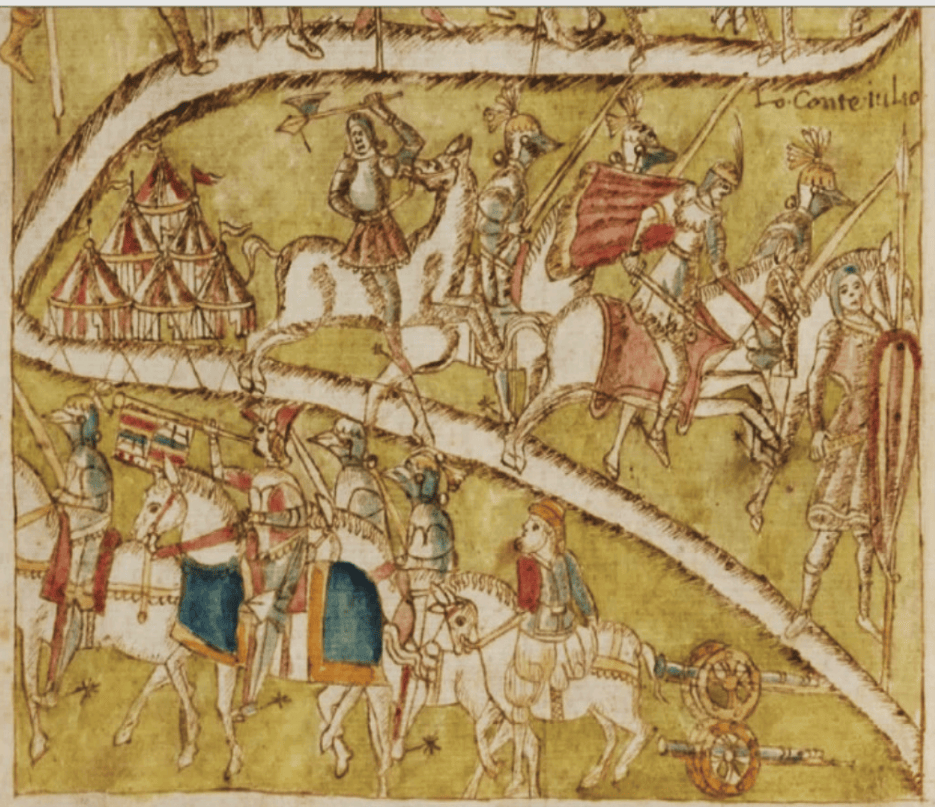
Skanderbeg’s men accompany Giulio Antonio I Acquaviva d’Aragona in the campaign for Otranto in 1481. The Italian soldiers are shown in armour and with high saddles, while the Stradioti ride without saddles or stirrups and wear light armour. Skanderbeg’s son, Giovanni Castriota,[17] was present at the battle. He may be the man beside Aquaviva. Aquaviva was beheaded in one of the ensuing skirmishes. Fasciculus temporum, MS M.801, fol. 81v, Morgan Library & Museum.[18]
Skanderbeg’s son later lived for many years with his mother, Andronica Arianiti-Comneniata, in Castel Nuovo in Naples, side by side with Ferrante. The recent discovery of the floors of the stables in Castel Nuovo therefore acquires entirely new significance. In a sense, they are the very ground from which equestrian combat techniques were introduced into Europe and enhanced into modern Equestrian Art.
Giovanni (or Gijon) later became a Neapolitan horse breeder as Duke of San Pietro in Galatina.[19] Federigo Grisone[20] still mentions his stud. Giovanni himself rode a ‘Turk’, that is, a horse originating in the Ottoman territories and probably descended from the ancient Niseans.
It is therefore no coincidence that the new Equestrian Art was later called ‘Stradiotic’ in Spain, Ferrante’s homeland, while in Italy it was described as ‘Spanish’. Yet neither the Stradioti nor the Spaniards ‘invented’ it, even if Ferrante enhanced it. Its basis is much older and is already depicted among the ancient Persians, including the ‘Spanish walk’ so popular today.[21] The connection between this equestrian style and the Medes and Persians is indicated by Xenophon’s Cyropaedia, which Alfonso got translated for his son as early as 1438. The Aragonese were therefore familiar with the origin of their horses and the appropriate riding techniques.[22]
Under Alfonso V of Aragon—who became Alfonso I, King of Naples, in 1442—Spanish and Moorish influences and horses were added to the Byzantine horses (which, as noted, were called ‘Turkish’). The new horse was bred, but Cesare Fiaschi already feared and regretted the resulting crossbreeding in 1556. Grisone believed that only under the Aragonese were the horses still ‘truly good’. Pluvinel and Guérinière later openly complained that they no longer possessed the true horse of Equestrian Art.[23]
What they apparently no longer possessed was the Nisean inherited from antiquity, which had been crossed too freely with local mares. Nevertheless, it has left genetic traces that survive to the present day.
The spectacular High School was invented only because of the talents of this Nisean-descended horse. The rider jumped with it because the horse possessed the necessary qualities. If one looks for this horse today, one may still find it in Spanish and Portuguese bullfighting horses (and one might almost say: only in these).[24]
If today’s breeding were focused on the horse’s qualities rather than on false traditions, supposed origins, or nationalist misconceptions about ‘pure’ breeds, the Nisean could certainly be ‘recovered’ from the PRE and Lusitano horses descended from it. It should be remembered that the word and concept of ‘breed’ in its strict application only emerged in the context of the Aragonese efforts described here, and at that time it meant nothing more than ‘stud’. Thus, when Grisone described the ‘Razze del Regno’, he was by no means referring to 136 different horse breeds in Campania and Apulia.[25] The concept of purity then came from the Habsburgs, above all from Philip II, who ultimately brought about the extinction of his own family through it.
From the final years of Ferrante’s reign onwards, Neapolitan riding instructors and horses began appearing at the courts of princes throughout Europe. Examples include Carlo Theti (Christian I, Dresden), Giovanni Battista Ferrara and his son Pirro Antonio (Philip II, Spain), and Giovanni Battista Pignatelli (Orsini and Farnese, Rome), among others.
The more the Neapolitan horses were needed on the battlefield, the more famous they became.
Grisone writes, for example, about the breeding operation of Angeluzzo dello Tito in Basilicata, whose brand, he says, was sent to him by King Francis of France after a horse from this breeding operation had carried him to victory at the Battle of Marignano. For this reason, Francis sent an agent every year to purchase foals from the herd.
These horses won in close combat—and in doing so saved lives. The lives of kings.
The same is reported of Enrico Pandone, who bred and trained the stallion San Giorgio at Venafro and sent him as a gift to Emperor Charles V, doing the same for other rulers.[26]
It is thus clear that from the end of the fifteenth century the region around Naples supplied horses to the whole of Europe and trained them before delivery. And it soon ‘produced’ the corresponding ‘user manual’ as well: Neapolitan riding instructors. They became increasingly important the more the wheellock pistol gained ground.
Even when Charles III left Naples for Madrid in 1759,[27] he still took with him, alongside 80 Neapolitan horses, numerous Neapolitan riding instructors and stable masters. He left the Neapolitans themselves with the failed crossbreeding experiment of Persano. There, as elsewhere, the horse bred for Equestrian Art had been crossed with the English Thoroughbred (that is, descendants of the Darley Arabian, itself of Akhal-Teke ancestry). The experiment led from then on to the decline of the Neapolitan horse, which had until then been so famous.
One question, however, has largely remained unanswered. Where did these Neapolitan riding instructors learn their art? How is it that around the year 1500 they suddenly swarmed out, like bees from a fertile hive, to all the great courts of Europe—and knew so much more than everyone else?
Where was their school? And … did it exist at all?[28]
King Ferrante’s Riding School?
Today, particularly in German-speaking countries, one often hears of supposed riding academies and encounters the term “academic riding.” This misconception was probably introduced by the historical assumptions of the French riding master Guérinière.
The development, teaching and transmission of the new Equestrian Art probably first took place within the Aragonese royal family and its branches. The affinity with horses was part of their tradition. Ferrante’s uncle by marriage, Dom Duarte of Portugal, had already written an important riding book.[30] Ferrante subsequently wrote letters and riding instructions to his children and grandchildren on a regular basis, sometimes including translations of older texts, such as Ruffo’s. It is therefore no coincidence that the new Equestrian Art first took a second hold in Ferrara and Mantua.[31]
It may then have been that a more permanent form of instruction was sought. The reason for this development was that Equestrian Art, with its tight voltes and complex manoeuvres, required considerably more years of study and horse training than simply riding in a straight line. One may assume that the initial aim was to train royal offspring and members of the nobility to become military commanders and, above all, skilled close-combat fighters. Perhaps Neapolitan riding masters did then, however, also become princely—and therefore highly important—gifts of state in their own right, much like Neapolitan horses.
Federigo Grisone, Claudio Corte, and others give us various hints.
- Grisone writes in 1550, in his legendary Ordini di cavalcare: “Messer Vincenzo Respino told me that he had a difficult, very old horse in the King’s Cavallerizza…” and then he describes how he teaches it.
- Antonio Pirro Ferraro also mentions Respino towards the end of the sixteenth century and says that he once worked for King Ferrante in his Cavallerizza.[32] He then provides a long list of riders who had been trained in Ferrante’s Cavallerizza or later in that of the Habsburg kings. He identifies their respective teachers and teaching relationships, as well as numerous other riders and their masters. He also mentions Monte Pagano as “Cavallerizzo maggiore del Serenissimo Don Ferrante d’Aragona.”[33]
- Claudio Corte, for his part, writes in 1562:[34] “My father was a master of the stables in that happy age when horses were truly good, and good riding masters were held in high esteem and very well rewarded. He was stable master to that most regal and never sufficiently praised lady, Isabella of Aragon, daughter of Alfonso, the lame King of Naples, and Duchess of Milan. Since I myself served this divine lady as a page, together with no fewer than thirty-five others, all of noble birth, I learned the principles and the greater part of what I know and set down in this book.”
The outstanding Neapolitan riding masters of the sixteenth century were thus trained within royal, or at least high-aristocratic, circles and their Cavallerizze.[35] At first, the training seems to have centred on King Ferrante, but his son Alfonso is soon mentioned, followed by his daughter Isabella, and then Philip II of Spain, or the viceroy appointed by him, and so forth.
Ferrante, however, appears to have been the starting point.
The name of Ferrante’s stable master has survived: Monte Pagano. We also hear of his son Cola.[36] And, remarkably, Cola Pagano is credited by Ferraro with nothing less than the invention of the volte (torni) that every rider still learns today, like an echo of his work. Whether riding dressage or not… Once introduced, these figures are still repeated by show jumpers, Western riders, and riders of sport horses based on the Akhal-Teke.
When the Aragonese began to encourage more organized teaching, and where this took place, are questions that shall be investigated here.
A document provides information about the possible beginnings: it reports the visit of the Habsburg Emperor Frederick III to Naples in 1452.[37] After his coronation, he came to Naples to celebrate his marriage to the niece of Alfonso of Aragon. Everything suggests that he then took the idea of the new Equestrian Art home with him. Together with the closely related Wettins, he became a first patron of Equestrian Art in the German-speaking lands and beyond.
Frederick must therefore have been impressed. Indeed, Alfonso did everything possible to excite him—and the young King of Hungary, who was also present—with hunting and displays of horses.
The account[38] of their joint excursion reads:
‘And they reached the vicinity of a palace on the Piano di Palma, which His Majesty had rebuilt on older foundations, two miles from the town of Nola. It stood in the countryside, from which there was an exceptionally wide view in every direction: around the palace the flat plain stretched for eight or ten miles, surrounded by hills and, at its boundaries, the mountains.’
The court party goes hunting. The report continues:
‘And on the third day of the hunt they departed from the aforementioned palace (which contained a large Cavallerizza, full of horses. All the foals came from the valleys of Calabria; they were branded on the head with the King’s mark and on the hindquarters with the arms of the kingdom. There were 2,000 horses in all. These stables had been fitted out so well for the said King Alfonso.)
After travelling five miles from the said palace and two miles from the area around San Marzano, they found another residence, although it did not have as many halls and rooms as the first. Yet the stable and Cavallerizza were just as large as the first, with very large courtyards and very convenient quarters for the servants.
And in this Cavallerizza there were another 200 horses, foals from other breeding operations in Calabria, bearing their marks and arms and branded on the hindquarters with an N, which was said to signify the breed of the nobles. All of them were exceptionally large and noble Corsieri.
The said Cavallerizza had been built on His Majesty’s orders, but Don Ferrante of Aragon, the only son of King Alfonso, served as its stable master.
And this Cavallerizza is called La Longola.
When they arrived there, they ate in the morning, and His Majesty had the aforementioned horses led past one by one on the cavesson. Since the stables had two gates, the horses, after being led out through one, entered again through the other. Don Ferrante of Aragon served there permanently as stable master, and he was exceptionally skilful and conscientious in his service.’
We therefore learn that in 1452 there existed two Cavallerizze near Vesuvius close to Naples.
According to the account, both lay in the Aragonese hunting grounds not far from the Sarno. We also learn that Crown Prince Ferrante took particular care at Longola of a smaller group of ‘noble’ horses and even served as their permanent stable master. One may therefore assume that the horses at Longola were more important to him. Perhaps they were the trained stallions, while the foals and mares were kept at the other breeding establishment mentioned above? Both institutions were, according to the account, extremely well equipped, but the first Cavallerizza had considerably more space for the court party.
One thing is certain: a major reason for concentrating the royal horse establishments in this area was probably the available pastureland. Two thousand two hundred horses had to be fed. At a very rough estimate of about one hectare of pasture per horse, this would have required approximately 2,200 hectares.
The First Cavallerizza
To locate the first Cavallerizza mentioned in 1452, we therefore know that in the Aragonese period it lay in an uninhabited plain, the Piano di Palma, two miles from Nola, five miles from Longola, and three miles from San Marzano. It stood on older foundations, and it stood exceptionally alone.
On a historical map from 1642, we indeed see a Cavallerizza marked directly beside the Augustan aqueduct, which is now mostly lost. On the map it lies in a straight line between Palma and Vesuvius on the side of the mountain. The architect Lettieri[39] confirms as well and as early as 1560, that a Cavallerizza stood by the aqueduct.
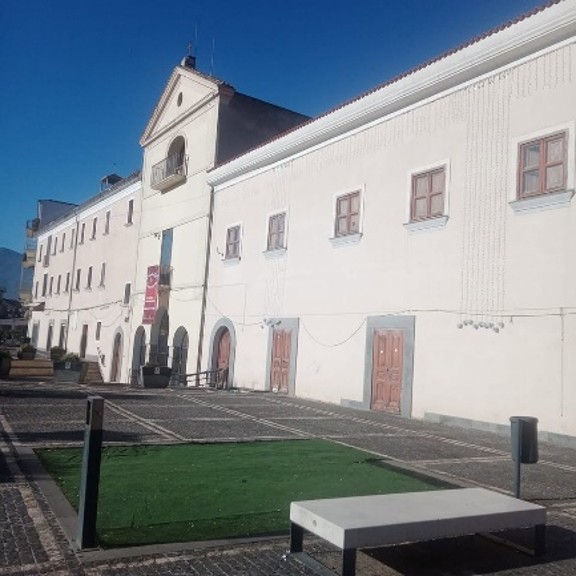
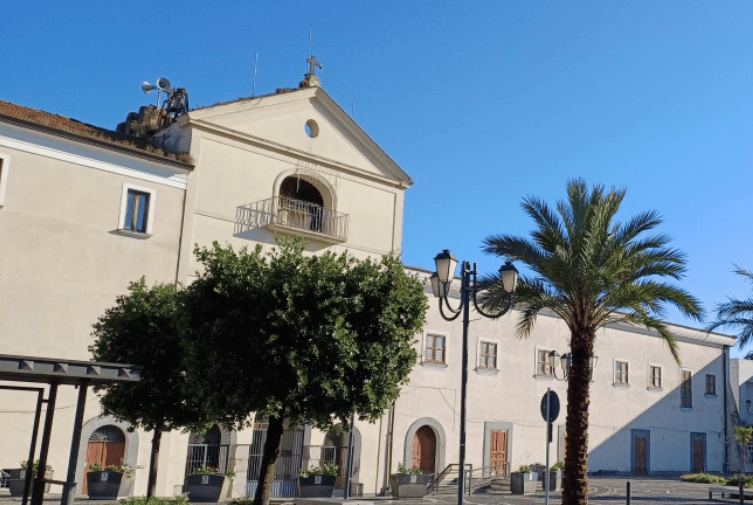
The present Convent of the Frati Minori in San Gennaro Vesuviano. It may be assumed that it incorporates parts of the stables of Ferrante’s riding school.
Another, later clue is provided by the Baroque cleric Remondini.[40] He writes that in the area of Sirico, which was considered part of the Piano di Palma and lay on the plain below the hill of Castello, the ruins of a huge structure could still be seen in the mid-eighteenth century. It had supposedly been built by King Ferrante and used as a royal stable, with accommodation for the falconers who accompanied him when hunting kites and eagles. Sirico is here the old Casale di Sirico, which today belongs to Saviano. The problem, however, is that no archaeological remains of such a huge building have been found there.
A better candidate for the location of the Cavallerizza lies nearby, in San Gennaro Vesuviano. It should be noted that in Renaissance times it was yet uninhabited, but there was an older building on which the Cavallerizza could have been built: a chapel with accommodation for pilgrims. After the devastating eruption of Vesuvius in AD 472, the area had been covered by dense woodland.[41] Alfonso of Aragon had it cleared so that falconry could take place there. He may also have used the existing chapel – or at least the housing of the pilgrims – dedicated to Saint Januarius as the basis for his Cavallerizza.
This chapel of San Gennaro was unquestionably enlarged—with a Cavallerizza, either at that time or later. When it was transferred to the Frati Minori in 1613, such a facility is explicitly mentioned.
What, then, are we to make of Remondini’s reference?
He apparently saw the Cavallerizza of King Alfonso lying in ruins in the eighteenth century. Yet did he see it close to Sirico, 4 km further? The fact that he (apparently) distinguishes the ruins of a royal Cavallerizza from the still-standing monastery, which he must have known, initially argues against identifying the two complexes as one. It does not, however, rule it out. Remondini may just have awkwardly formulated the indications of his text. San Gennaro emerged as village only in the 19th century.[42] He may just have looked for a name to give to the isolated place in the plain.
Two further clues remain on which we can base our search.
- San Marzano: The description of the Cavallerizza visited by Alfonso in 1452 mentions a nearby ‘San Marzano’. A place called Marzano lies approximately 6.5 km from both Sirico and also from San Gennaro Vesuviano. It fits both locations, but it does not help us decide between them.
- The aqueduct: In 1560 Lettieri writes that the Augustan aqueduct ran over the ‘Cavallerizza and from there via the Masseria of San Martino and other places to below Santa Maria del Pozzo’. The Masseria is now forgotten, but the church still exists. It is located in Somma Vesuviana. New research on the route of the aqueduct indicates that its principal course ran aside San Gennaro Vesuviano, not Sirico/Saviano. Only a branch passes near Saviano, and this branch does not connect it with Somma.
Further support comes from a documentary reference to a Cavallerizza dating from 1493. Ferrante’s reign had for many years been marked by war and internal conflict within his kingdom. Only 1492 marked a turning point. For a brief moment, peace seemed possible. And it appears that he used the opportunity.[43] In 1493 he ordered works on a Cavallerizza for 120 horses in the Piano di Palma, in the territory of the County of Nola. The estimated cost was 500 ducats. This was a substantial sum, but by no means overwhelming. Giacomo Barrile, then governor of the County of Nola, was entrusted with carrying out the project. He was permitted to use the remaining revenues of the county to finance it.[44]
Where the work was carried out is not mentioned. Ferrante may have been referring to a new construction, or, more probably, he may have ordered the rebuilding of the existing Cavallerizza near the Augustan aqueduct. As mentioned above, one hundred and twenty years later, in 1613, there is firm evidence for the existence of a Cavallerizza in San Gennaro Vesuviano.[45]
Documents show that Scipione Pignatelli, Count of San Valentino and Marquis of Lauro, made a generous donation in 1613 to Bishop Fabrizio Gallo of Nola, in favour of the Reformed Friars Minor of St Francis, by means of a deed drawn up by the notary Galeota in the episcopal curia of Nola. As part of this donation, he gave a church and a Cavallerizza. The Marquis also established the Fiera, the annual fair that is still held today and which was strongly oriented towards horse breeding and horse trade. [46]
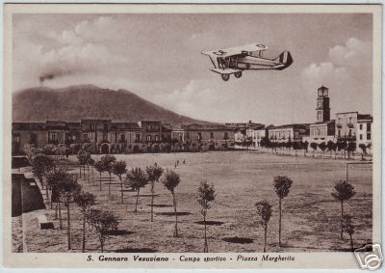
Left: Piazza Regina Margherita in San Gennaro Vesuviano. The photograph from the 1930s gives an impression of how much larger the riding ground was than those later in use, when the length of riding grounds began to be adapted to the length of a career. (The riding ground is still called carrière in French.)
The evidence therefore permits the hypothesis that the present-day Convento Francescano dei Frati Minori of San Gennaro Vesuviano at least partly overlies the remains of the older Aragonese equestrian complex.
The historic centre of San Gennaro, with its spacious Piazza Regina Margherita, would in this case have served as the riding ground. One will search in vain for a riding hall. Riding halls were not yet known at the time. Nor will one find layers of sand. It was precisely the exceptional quality of the soil around Naples, enriched by volcanic ash from Vesuvius, that made the area so suitable for horse breeding. [47]
The evidence therefore allows us to assume that the Aragonese Cavallerizza, dating from around 1452, was located on the site of present-day Convento Francescano dei Frati Minori in San Gennaro Vesuviano. This is further supported by the existence of a remarkably well-matched building in the town: the monastery of the Frati Minori.
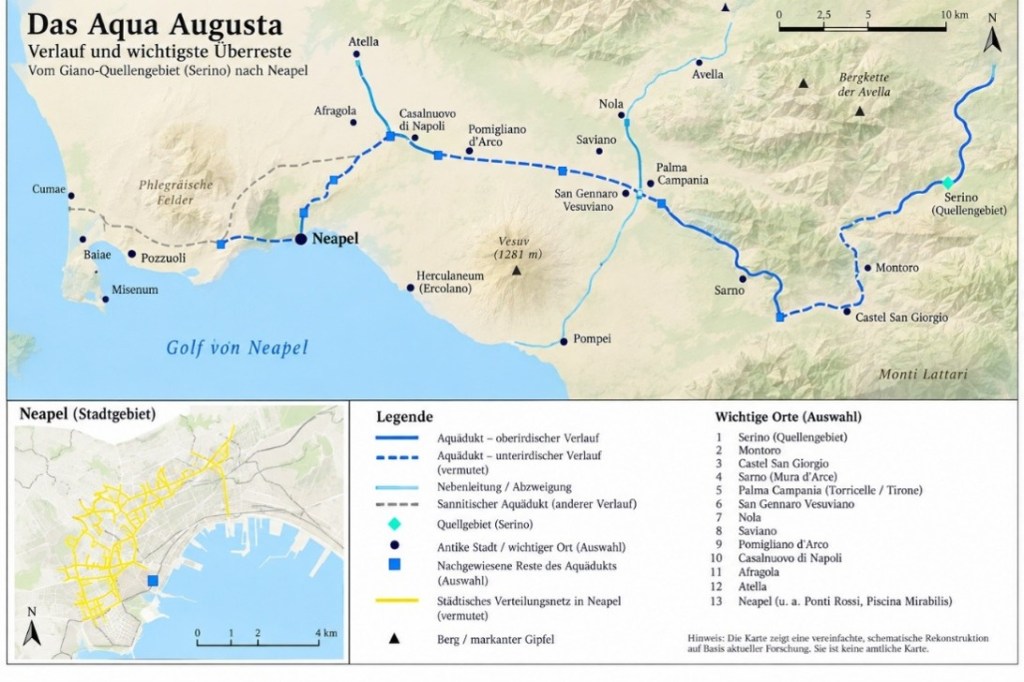
The location of the Augustan aqueduct according to current research. The Lettieri map appears to indicate the location of the Cavallerizza at San Gennaro. Compared with the historical map below, Saviano lies on the side of the aqueduct facing away from Vesuvius and is therefore on the wrong side. Redrawn after Esposito, L.; Ginolfi, M.; Leone, G.; Fiorillo, F., Geo-Hydrological Characteristics That Contributed to the Choice and Configuration of the Ancient Roman Aqueduct Aqua Augusta from Serino Springs.’ Water 2025, 17, 3342.
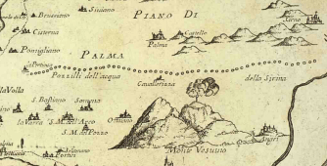
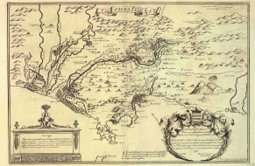
A historical map from 1642, showing ‘Campania felix’, the happy Campania, together with an enlarged detail. On the plain behind Vesuvius, directly beside the aqueduct marked on the map, one can read the word ‘Cavallerizza’.
The Second Cavallerizza at Longola
The second Cavallerizza can be located with confidence. It stood in the Longola area, today divided between Poggiomarino and Striano, immediately beside the Sarno. An official planning document[48] of the municipality of Poggiomarino still explicitly designates a large part of the area as ‘Cavallerizza, denominata Longora o Longola’, which the Aragonese rulers used as pasture for the horses of the court and army. Two drawings of the building also survive. They show a simple structure with small windows and a tower.[49]
A catastrophic battle at the Cavallerizza in 1460 probably made Ferrante dislike the place. He escaped to Naples with only four horses. From then on, he was almost constantly at war, until, 32 years later, he finally secured papal recognition of the Aragonese succession. It appears that the Cavallerizza at Longola fell into decay after the battle. No secure traces remain.
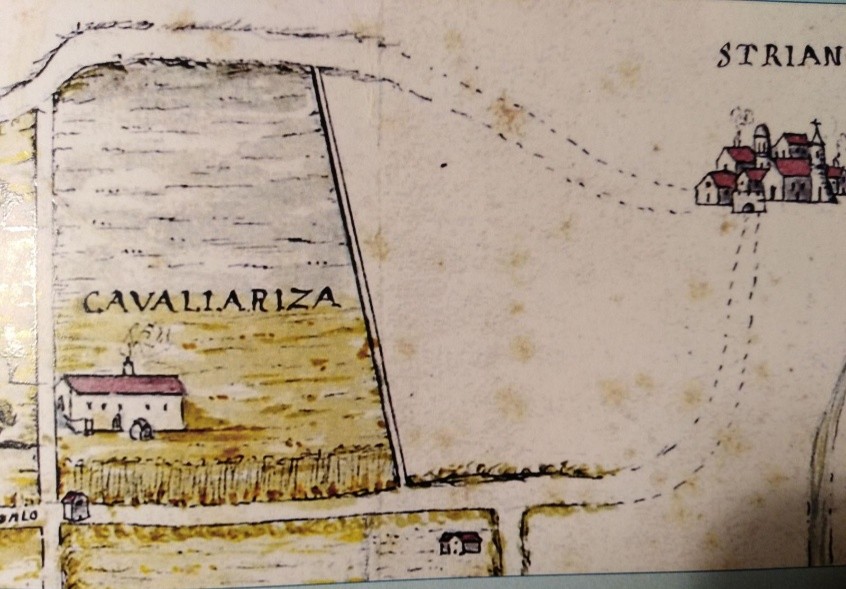
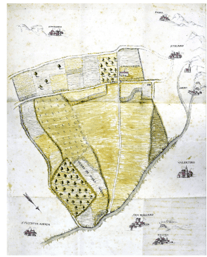
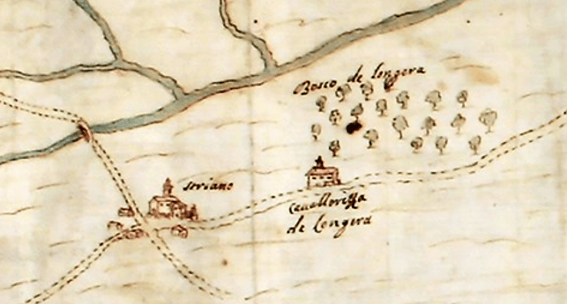
This map shows the Cavallerizza of Longola. La Valle del Sarno, in ASNa, Raccolta piante e disegni, cart. XXXII-23, La Longola. + La Cavallerizza di Longola (enlarged detail, right), in ASNa, Arch. Saluzzo di Corigliano, B. 60. In SYLVA MALA XXIV – 2022, p. 17 – Felice Marciano, Pasquale Marciano, Angelandrea Casale, Una cronaca del Quattrocento: la battaglia della Longola.
The Third Cavallerizza at Castel Capuano
A third Cavallerizza belonging to the Aragonese can be located at a later date in Castel Capuano in Naples.[50] Under Alfonso of Aragon, Duke of Calabria and son of King Ferrante, the Castel developed during the 1480s into a central component of an extensive Aragonese residential complex in eastern Naples.[51]
A Cavallerizza can be documented there for the year 1488. Between February and September of that year, the Florentine architect Giuliano da Maiano worked on its completion.[52] Contemporary sources[53] report that between 1484 and 1491 the Duke presented the horses of his residence there to foreign nobles.
It should of course also be mentioned that Ferrante’s stables were located in the Castel Nuovo, and that their floors have been discovered. These are older than the Cavallerizza at Castel Capuano.
It is likely that the horse on which Alfonso of Calabria, the son of King Ferrante of Naples, performed the first documented school movements over jumps on 18 September 1477 was trained either at the Castel or in one of the two Cavallerizze in the Piano di Palma.
The Cavallerizza del Re in Naples (1581)
It appears that Ferrante’s Cavallerizze had later a successor within Naples. The Spanish viceroy of the Kingdom of Naples, Juan de Zúñiga y Requeséns, Prince of Pietraperzìa, had a structure called the ‘Cavallerizza del Ré’ built in 1581—shortly after the Caballerizzas Reales were established in Córdoba and Madrid—near the Maddalena Bridge in Naples, close to the eastern Aragonese city wall. It was intended for the training of the riders of the viceregal army and was built on the foundations of an older Aragonese bastion.
Battista Caracciolo names Giuseppe D’Alessandro,[56] Duke of Peschiolanciano, Marquis of San Erasmo, as the first stable master.
After it was damaged during the Masaniello riots in 1648, it was restored. By the time of Charles II of Spain, however, it had already been more or less abandoned, and a site for animal hunts was added in the form of an enormous flight of steps, known as the Serraglio. It was subsequently greatly enlarged by Vanvitelli and converted into a Baroque military barracks. The Serraglio[57] was destroyed during the Second World War. This Cavallerizza, too, only acquired a covered riding area in the form of a portico after the alterations of 1648.
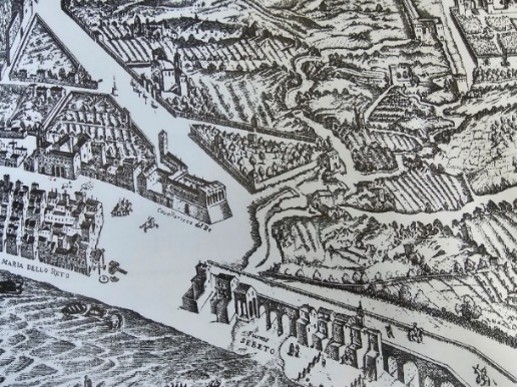
The Cavallerizza del Re at the Maddalena Bridge in Naples, dating from 1581. It accommodated 200 horses and was built on an older Aragonese bastion. This resulted in an irregular structure, and the riding school was later converted by Vanvitelli into military barracks. In this later form it survives today as the Bianchini Barracks. Veduta by A. Baratta, 1670, probably based on a drawing of 1611.
Today there are no functioning Renaissance riding grounds left in Naples or its surrounding area, and hardly any remains of the 136 breeding studs listed by Grisone. Of the Cavallerizza for the King’s horses near Nola, only the empty space in the centre of San Gennaro Vesuviano survives.
Otherwise, only place names remain, such as the Cavallerizza near Ostuni, where the Sanseverino are said to have maintained their stable beside their stud at Serre, or a few street names.[58] The Massa Cavallerizza[59] in Alberobello, the Aragonese and later Venetian stud, survives as a standing building, as do a few later barracks.[60] A historic riding hall and stables from the Baroque period still exist in the Royal Palace of Naples, but they stand empty.
The turbulent history of rule over Naples, in which French and Spanish powers alternated, [61] as well as the soft volcanic-ash soil, appears to have kept the Neapolitans of the Renaissance dependent for a long time on the use of fields and open spaces for training, exactly as described in Grisone’s book.
There were, however, soon more permanent facilities and riding schools at the princely courts of northern Italy. Particularly important was King Ferrante’s influence on his grandchildren in Ferrara and Mantua.
Ferrante of Naples’s grandson, Duke Alfonso, had received riding instructions from him and brought Neapolitan Equestrian Art to the court of Ferrara. His sister Isabella d’Este followed suit in Mantua, where the Palazzo Té and its Sala dei Cavalli produced the most beautiful surviving stable in the world.[62]
Conclusion: On the basis of the evidence discussed above, it can be argued that the concept of a riding school for Equestrian Art emerged among the Aragonese from their courtly training of pages and young nobles within the Cavallerizze. King Ferrante of Naples (Ferdinand I) appears to have played a central role in this development. The evidence further suggests that one of the principal early centres of this tradition may have been the Aragonese Cavallerizza in the area of present-day San Gennaro Vesuviano.
[1] Cesare Paderni, head of riding instruction at the Pinerolo riding school, writes on page 185 of his lectures for the 1891 master’s course: ‘In 1134 various squires who worked in the circus of Constantinople left that city and went to Naples, the last land in Italy that still recognised the authority of the Byzantine emperors, and there founded something like a riding school.’ It is not known where Paderni obtained this information. The Enciclopedia Treccani likewise points to the arrival in Naples in 1134 of seven Byzantine grooms, allegedly sent by Michael IV, known as the Paphlagonian, emperor of the Byzantine Empire, to give instruction in the city. Michael IV Paphlagonian, emperor from 1034, died in 1041. He therefore could not have initiated this project 93 years after his death. John II was emperor in 1134. Since 1034 was the year of Michael’s accession, one should instead probably start from that date.
[2] The wheellock pistol gained importance from the Battle of Mühlberg in 1547 onwards. Its initial weakness is important: when firing, it had to be braced against the opponent’s armour, which explains the importance of applied equestrian skill. This also explains why the seminal book on equestrian art, Grisone’s Ordini di Cavalcare, did not appear until 1550. At this point Augustus of Saxony and his son Christian I emerged as important patrons of equestrian art. Augustus’s brother Maurice of Saxony – one of the winners of Mühlberg – died in 1553 in such an exchange of fire while performing an equestrian manoeuvre.
[3] Emperor John VIII Palaiologos, Patriarch Joseph II of Constantinople, Bessarion, Plethon and hundreds of other Greeks spent months in Italy in 1438–1439. The Council was first held in Ferrara and, from January 1439, in Florence; the union of the Churches was proclaimed there on 6 July 1439.
[4] There were nevertheless many points of contact. To give one example: Niccolò Sagundino was the official interpreter at the Council of Ferrara and Florence in 1438/39. He had known Bessarion since youth and maintained close contact with him during the Council. After the fall of Constantinople, Sagundino was sent to Naples in 1454 and on 25 January 1454 delivered an extensive presentation before Alfonso V at the Neapolitan court on the Turks, Constantinople, and the political possibilities of the West. Alfonso had the presentation immediately committed to writing.
[5] Alfonso conquered Naples in 1442. A very close political connection between Naples and Ferrara then developed. Leonello d’Este, together with his brother Borso, formed an alliance with Alfonso. An Este embassy came to Naples in 1444–1445. Leonello d’Este then married Maria d’Aragona, a natural daughter of Alfonso V, in 1444. Ercole and Sigismondo d’Este grew up alongside Ferrante in Naples.
[6] Ercole d’Este was sent with his brother Sigismondo to the court of Alfonso V in Naples in 1445, where he remained until 1460 and earned a reputation as a knight. Trevor Dean, ‘Ercole I d’Este, duca di Ferrara, Modena e Reggio’, Dizionario Biografico degli Italiani, vol. 43, 1993.
[7] See Fan S. Noli, George Castrioti Scanderbeg (1405–1468), New York 1947, p. 105, citing Giammaria Biemmi, Istoria di Giorgio Castrioto Scanderbeg, lib. I, who reports that ‘Conte Urana’ (Vrana Konti) had previously taken part in several campaigns in the army of Alfonso V of Aragon. The statement should be treated with source-critical caution, since Biemmi’s work is considered a problematic source.
[8] The Hittites, Medes and then Persians all lived on the same Cappadocian plateau around present-day Kayseri (Turkey), extending into northern Iran. The area was conquered at times by Byzantium. Nisean is the Hittite name for “Hittite”.
[9] Herodotus, Histories 3.106; 7.40; 9.20; Aristotle, Historia animalium 9.50; Strabo, Geographica 11.13.7; 11.14.9; Oppian, Cynegetica 1.312 ff.; Vegetius, Mulomedicina 3.6.
[10] Fages, Antoine et al. (including Ludovic Orlando), ‘Tracking Five Millennia of Horse Management with Extensive Ancient Genome Time Series’, Cell 177(6), 2019, pp. 1419–1435.e31. DOI: 10.1016/j.cell.2019.03.049.
[11] Ulrike Ortrere, the History of Horseback Riding
[12] Archivio Storico per le Province Napoletane, XXXIII (1908), fasc. 3, pp. 481–490.
[13] In the latter cases the horse was coloured red up to the belly. See Zacharias Wehme, SLUB, Dresden, and the drawings of the Dresden Inventions by Daniel Bretschneider (Ulrike Ortrere, Die Dresdner Inventionen).
[14] The usual images of the Stradioti that do not derive from riding manuals mostly show them using the seat of the gineta style.
[15] This is said to have existed in Adrianople (Edirne) before the fall of Constantinople, and Skanderbeg is said to have learned there, but this is not certain.
[16] See the Akinci.
[17] Biography of Giovanni Castriota, Principi d’Albania website, accessed on 3 February 2025 – http://www.castriotascanderbeg.it/biografie/8-biografia-giovanni. Having been enfeoffed with the counties of Monte Sant’Angelo and San Giovanni Rotondo (and later also with the counties of Soleto and San Pietro in Galatina), Giovanni, heir to the Castriota family, remained faithful to his father’s tradition. As commander of the Neapolitan army, he fought with great determination for at least twenty years, beginning in 1480, when he hastened to Otranto to fight his natural enemy. Eventually, he even carried the war into his ancestral homeland, by then an Ottoman province, and decisively defeated a contingent of the Turkish army at the head of 4,000 infantrymen. See Francesco Storti, “Fanteria e cavalleria leggera nel Regno di Napoli (XV secolo),” Archivio Storico per le Province Napoletane, CXXXIII (2015), pp. 1–47, here pp. 31–32, on the development of Neapolitan light cavalry during the War of Otranto, which, according to Storti, was directly influenced by Albanian Stradiots as well as Balkan-Ottoman equestrian traditions.
[18] See, concerning the battle: Domenico Defilippis, I Castriota, signori di Monte Sant’Angelo e di San Giovanni Rotondo, fra mito e letteratura, University of Bari, available at https://www.archeologiadigitale.it/attidaunia/pdf/20-defilippis.pdf. Critical note: While the historical sources repeatedly draw attention to the horses and riding practices of the Stradiots under Skanderbeg, many modern scholars ignore or deny this crucial aspect.
[19] Gjon II Kastrioti (Italian: Ioanne Castrioto, Giovanni Castrioto; 1456 – 2 August 1514) was briefly lord of Krujë. He then became Duke of San Pietro in Galatina (1485), Count of Soleto and lord of Monte Sant’Angelo and San Giovanni Rotondo. As a horse breeder he is regularly mentioned as Duke of San Pietro in Galatina.
[20] Le Razze del Regno, Federigo Grisone.
[21] See the statue of a Persian rider in the Metropolitan Museum.
[22] See David Marsh, ‘Lorenzo Valla in Naples: The Translation from Xenophon’s Cyropaedia’, Bibliothèque d’Humanisme et Renaissance 46 (1984), no. 2, pp. 407–420; Luciana Saccardi, ‘La versione di Lorenzo Valla della Ciropedia di Senofonte: il senso politico-celebrativo di talune peculiarità della traduzione’, Camenulae 11 (2014), pp. 1–6, esp. pp. 1–2. In 1438 Valla translated the first part of the first book of the Cyropaedia for the young Ferrante; the translation was dedicated to Alfonso.
[23] Antoine de Pluvinel, L’Instruction du Roy en l’exercice de monter à cheval, Paris 1625; François Robichon de La Guérinière, École de cavalerie, Paris 1733.
[24] In Naples in 1550 appeared the first printed book devoted exclusively to equestrian art: “Gli ordini di cavalcare” by Federigo Grisone, published by Giovan Paolo Suganappo. It was extraordinarily successful and was soon translated into the major European languages. In Italy it went through sixteen editions between 1550 and 1620. Thus, from the sixteenth century, perhaps even from the end of the fifteenth, Naples offered riding lessons mentioned in histories and riding literature, such as those by Giovan Battista Pignatello or Pignatelli. François Robichon de La Guérinière, the most famous French riding master, writes on p. 60 of his École de cavalerie of 1733 that Giovan Battista Pignatelli, teacher of Monsieur de La Broue, ‘had an academy in Naples: this school had such a good reputation that it was regarded as the first in the world. The entire aristocracy of France and Germany wishing to perfect itself in cavalry was obliged to take lessons from this famous teacher.’ There is, however, as shown here no proof that such a genuine academy existed or that everyone undertook a pilgrimage to Pignatelli and no one else.
[25] From the Norman ‘harasz’ = stud. It is important to understand that historical terms such as ‘razza nostra’ did not refer to a breed in the modern sense. The same applies to maneggio (training/dressage, not a riding hall).
[26] The information appears beneath the image of the stallion on the wall of the fortress at Venafro.
[27] Charles had 80 horses—mares and foals—from his Neapolitan royal stables brought to Spain. They did not travel with the King by ship but were driven overland to Spain. The transport was supervised by the cavallerizzo di campo Luigi (Luis) Papagalli. The expedition set out in October/November 1759. By 20 December 1759 it was already in Rome. The animals then covered the enormous distance Rome – Florence – Turin – Lyon – Montpellier – Figueras – Barcelona – Zaragoza – Guadalajara – Aranjuez. They probably arrived in spring 1760, possibly only in June. Sanidad Militar, Sanid. Mil. vol. 77 no. 3, Madrid, July/September 2021, Epub 17 January 2022, ‘Los albéitares-mariscales y los caballos que vinieron de Nápoles a la caballeriza de Carlos III’. In commemoration of the 175th anniversary of the creation of the Spanish Military Veterinary Corps (1845–2020).
[28] Much of what followed is legend. Guérinière, for instance, rather freely attributes academies to the Neapolitans that probably did not exist in this form (cf. École de Cavalerie, 1733). Such terminological confusions are particularly common in the context of the Renaissance. One need only recall that, under Aragonese rule, an academy was a discussion club, while a university was an administrative body rather than an educational institution.
[29] Guérinière, Ecole de Cavalerie, 1733
[30] Dom Duarte, Livro da ensinança de bem cavalgar toda sela (‘Book of instruction on riding well in every saddle’). It remained unfinished.
[31] Eleonora d’Aragona, daughter of Ferrante I of Naples, lived in Ferrara from 1473; her daughter Isabella d’Este, Ferrante’s granddaughter, then lived in Mantua from 1490. Both cities developed a major equestrian culture through Ferrante’s influence.
[32] See also the references to Respino in Cavallo frenato, Antonio Ferraro Pirro, 1602: “Just as no plant grown under this influence has produced more branches than the house of Respino, which originated with M. Colerta, their predecessor, who had earned a good reputation through the long experience he had acquired and who spent a long time in the service of the late Don Ferrante of Aragon, King of this realm. From him the gentlemen Simone, Giannello, Vincenzo and Pinto di Respina received their training.
After the death of that glorious prince, Simone served the Duke Valentino and, after his death, the Gran Capitano, producing countless good and excellent horses while in their service.
Giannello served the young King Ferrante. This king loved horses more than any prince in the world. In his Cavallerizza, so many excellent horses were produced under his direction that some of them came into the possession of all the Christian kings and rulers, to his glory and praise.
Vincenzo was summoned, on account of his skill, to serve our late queens. After their deaths, he remained for a long time in the Cavallerizza della Maddalena in the service of Emperor Charles V, producing countless perfect horses in every kind of gait, to the satisfaction of his princely master….”
[33] Ferraro, Cavallo Frenato, 1602.
[34] “My father was a master of the stables (Cavallarizzo) in that happy age when horses were truly good, and good Cavallarizzi were held in high esteem and very well rewarded. He was Cavallarizzo to that most regal and never sufficiently praised lady, Isabella of Aragon, daughter of Alfonso the Lame, King of Naples, and Duchess of Milan.
Since I myself was a page to this most divine lady, among no fewer than thirty-five others, all noblemen, I learned the principles and the greater part of what I know and write.
To this I add that I also benefited from the good judgment of some of my friends among the gentlemen, especially that of the most magnificent Messer Horatio, son of Captain Mutio Muti, who was very accomplished in the liberal arts and other virtues; and also that of the Commendator Fra Prospero, a knight certainly endowed with many virtues and surpassed by few in the world when it came to riding. He too was a page among that fine company of thirty-five whom I have mentioned, and had the aforementioned Messer Giovangelo as his uncle and master, as did my father….”
Claudio Corte, Il cavallarizzo (1562).
[35] Among them were Pirro Antonio Ferraro and his father Batista, who taught at the Spanish court in Madrid. Carlo Theti was employed at the court of the Electors of Saxony. Jeronimo Tinti worked as head of the Spanish Caballerizzas Reales in Córdoba. Christina of Sweden and the English court also employed Neapolitans. In Caen, France, a certain Janus Geronimo from Naples is said to have been teaching as early as the beginning of the sixteenth century (Jean Rouxel, De instauratione cadomensis academiae oratio, Caen, Cavelier, 1536, p. 254 – there might have been a direct connection with the court of Ferrara through the Fiaschi family, from which two brothers served as ambassadors to France).
[36] Both Federigo Grisone and Pirro Antonio Ferraro mention the school. Ferraro is the one who credits Monte Pagano with inventing the school figures. Cavallo Frenato, 1602. Grisone learned from Cola Pagano, as he himself writes. Ordini di Cavalcare, 1550. The Archivio Storico Municipale di Napoli records an imperial diploma of 24 December 1480 concerning the legitimation of Paduano Pagano, son of the ‘Magnifico Monte Pagano’: Diplomi regi 117, 1480, Privilegio di legittimazione di Paduano Pagano figlio di Monte Pagano, Lettera Patentale dell’Imperatore Federico 3.°, dated at Salzburg 24 December 1480, granting the privilege of legitimation to Paduano Pagano, son of the Magnifico Monte Pagano, issued in Naples by the Count Palatine Pirro Luise Riccio under the powers received and authenticated by Notary Cirio Santoro. 2 RIP. 0047.
[37] Archivio Storico per le Province Napoletane, XXXIII (1908), fasc. 3, p. 481–490
„Come lo Imperatore Federico entrò in Napoli, e poi lo 4 dì entrò l’Imperatrice in Aversa“, online auf https://www.polodigitalenapoli.it (unter dem Jahr 1908)
[38] Archivio Storico per le Province Napoletane, XXXIII (1908), fasc. 3, pp. 481–490: ‘Come lo Imperatore Federico entrò in Napoli, e poi lo 4 dì entrò l’Imperatrice in Aversa’, online at polo digitale Napoli (under the year 1908).
[39] ‘And continuing along the foot of the mountain, [the aqueduct] emerges onto those aqueducts built on certain large brick arches, which lie along the road from Foce to Palma; then it returns along the foot of the mountain and emerges underground onto the plain of Palma, not along those aqueducts that appeared above ground; and, passing over the Cavallerizza across the said plain, by the Masseria of San Martino and other places, it reaches below Santa Maria del Pozzo.’ Pier Antonio Lettieri was an architect/engineer whom the viceroy Don Pedro de Toledo commissioned in 1560 to investigate and plan the restoration of the ancient aqueduct of Serino. His report, ‘Discorso dottissimo del Magnifico ms Pierro Antonio de Letchiero cittadino et Tabulario Napolitano circa l’anticha pianta et ampliatione dela Città di Nap. et del itinerario del acqua che anticamente flueva et dentro et fora la pred[ett] città per aquedotti mirabili quale secondo per più ragioni ne dimostra, era il Sebbetho celebrato dagli antichi auttori’, was published in 1803 by Lorenzo Giustiniani in Dizionario geografico-ragionato del Regno di Napoli, vol. VI, pp. 382–411.
[40] ‘Just before it lies Sirico, in the same broad and attractive plain called Piano di Palma—not because it falls under its jurisdiction, but because it lies below it and can be seen completely from there. There once stood a splendid palace, of which the magnificent foundations and impressive remains can still be found underground. According to some, it was built by Count Niccolò Orsini; others believe that it was built by the Kings of Naples themselves so that they could come here to hunt kites and eagles when this area was still covered by forests. This was done especially by King Ladislaus, Alfonso II, Ferdinand III and his son Alfonso III, and finally King Louis. Not far away lies the more populous Casale of Saviano.’ (Poco innanzi è Sirico situato nello stesso ampio, e dilettevole campo, che il Piano di Palma s’appella, non perché alla di lei giurisdizione s’appartenga, ma perché le sta sotto, e tutto esposto alla di lei veduta. Era qua ne’ poco fa scorsi secoli un magnifico palagio, di cui si trovano anche sotterra le sontuose fondamenta, e superbe vestigia, edificatovi a parer di taluni dal Conte Niccolò Orsini, o come altri credono, dagli stessi Re di Napoli per qua venire alle cacce de’ Nibi, e dell’Aquile, allorché eran queste ancor boscose campagne: come fecero particolarmente il Re Ladislao, Alfonso II. Ferdinando III. e ‘l di lui figlio Alfonso III. e finalmente ancora il Re Lodovico. E poco distante da questo è l’altro anche più popoloso Casal di Saviano.) Della nolana ecclesiastica storia alla santità di nostro signore …, Gianstefano Remondini, vol. I, p. 254.
[41] National cultural heritage catalogue entry.
[42] The settlement grew to become first a district of Palma Nolana and then, from 1841, an autonomous municipality by decree of Ferdinand II of Bourbon.
[43] After the long conflict with Pope Innocent VIII, who had even deprived him of his kingdom in 1489, reconciliation took place in January/February 1492. In June, papal investiture in favour of Ferrante’s legitimate male descendants was finally granted, thereby legally securing the dynastic succession of the Aragonese. At the same time, Lorenzo de’ Medici, one of the principal guarantors of the Italian balance of power, died. Ferrante had thus consolidated his immediate domestic and dynastic position, although the death of Innocent VIII in July of the same year and the election of Alexander VI soon placed him under renewed pressure.
[44] Luigi Tufano, ‘Potere feudale ed élite locale nel Mezzogiorno alla fine del Medioevo. Note sulla contea orsiniana di Nola’, in Alessio Fiore / Luigi Provero (eds.), La signoria rurale nell’Italia del tardo medioevo. 3. L’azione politica locale, Firenze University Press, 2021, p. 216, with reference to ASNa, Relevi Originali, 35, cc. 411–416, especially the Memoriale in the first mandate of 7 March 1493.
[45] At that time San Gennaro Vesuviano was not a separate settlement but part of the Feudo Palma Campania in the Pianura Campana. It became a separate municipality only in 1841 by decree of Ferdinand II of Bourbon. Before the Aragonese period it was more or less just a church and a forest. The municipality of San Gennaro Vesuviano lies in the Campanian plain (formerly known as Planum Palmae), today called il Piano, bounded by Vesuvius and Monte Sant’Angelo. The Piano forms a natural geological connection between the Nocera–Sarno area and that of Nola. In the Aragonese period the area served as hunting ground for falconry and for horse breeding. A deed as late as 1631, by which Scipione Pignatelli, Count of San Valentino and Marquis of Lauro, through the notary Galeota made a generous donation to the Bishop of Nola, Monsignor Fabrizio Gallo, in favour of the Reformed Friars Minor of Saint Francis, mentions both a church and a Cavallerizza. The horses of the rulers of Naples were brought to Naples in 1581 and thereafter trained in the area of the present Bianchini Barracks. 1631 was the year of the last major eruption of Vesuvius, with more than 3,000 deaths.
[46] The Fiera Vesuviana has been held continuously since 1613. It was founded by Marquis Scipione Pignatelli, lord of Palma and Lauro, who transformed the long-established festival of Saint Januarius, celebrated with a large popular following before the medieval church of Sant’Januarius in Silvia, into a fair. The church stood in the middle of the Planum Palmae, where King Ferrante’s old Cavallerizza was located. Municipal website.
[47] The first riding hall in the world arose at the end of the sixteenth century from a Jeu de Paume near Dresden Castle, where a first purpose-built riding house was then constructed in 1618. There may also have been a riding house in Weimar built shortly before the latter.
[48] The planning documents of nearby Poggiomarino state, without giving a source: ‘The territory of Poggiomarino, together with that of Striano, formed an integral part of the County of Sarno, which in 1495 was granted by Ferrante II to Gironimo Tuttavilla. A large part of this territory belonged to the so-called “Cavallerizza”, called Longora or Longola, which the Aragonese ruling house designated as pasture for the horses of the court and army.’ Proposta Metodologica e Programmatica.
[49] See also Luigi Ambrosio, Pasquale Marzano and Felice Marzano, La regia Cavallerizza di Longola nel territorio di Striano, published 2017.
[50] Castel Capuano, originally constructed as a Norman-Staufen fortress at the eastern entrance to Naples, was situated by the late fifteenth century directly within the urban area expanded by the Aragonese. With the relocation or construction of a new eastern city fortification in 1484, the fortress was integrated into the urban fabric and lost its original function as an advanced military strongpoint. It increasingly assumed the role of a courtly residence. See Istituto Italiano dei Castelli – Sezione Campania, Castel Capuano, concerning the incorporation of the castle into the new city fortifications in 1484 and the resulting loss of its military function.
[51] This complex also included the Duchesca, laid out in the gardens of the Castel, as well as the Villa of Poggioreale, located outside the city walls at the time. Guido Beltramini / Benedetta Gravagnola and the relevant scholarship on the Aragonese residential landscape describe Castel Capuano as the centre of a network of residences developed by Alfonso d’Aragona, Duke of Calabria, which included the Duchesca and Poggioreale. See in particular the research on the Aragonese transformation of Castel Capuano.
[52] “A considerable amount of information has survived concerning the works at Castel Capuano. There Giuliano da Maiano remained from February to September 1488 awaiting the completion of the Cavallerizza, a new corridor with several adjoining rooms overlooking the roof garden, a bathroom and an oratory. For the Cavallerizza, the timber was supplied by Cristofaro Longobardi of Naples, while the Neapolitan master Natale de Perso and a certain Jacopo from Florence worked on it.” Napoli nobilissima: rivista d’arte e di topografia napoletana, 14 (1905).
[53] On 14 December 1488, just a few months after the documented construction work on the Cavallerizza, Leostello records that Alfonso went to the stables in the evening and showed several of his horses to a number of Lombard gentlemen. On 17 December, he reports again that, following the departure of a guest, the Duke went to see his horses and presented them to the relevant marquis and other Lombard gentlemen. Joampiero Leostello, Effemeridi delle cose fatte per il duca di Calabria (1484–1491), ed. Francesco Trinchera, in: Documenti per la storia, le arti e le industrie delle province napoletane, I, Naples, 1865, pp. 182–183; the entries for 14 and 17 December 1488 are cited in the art-historical scholarship on Castel Capuano.
[54] In 1581 Juan de Zúñiga y Requeséns, Marquis of Pietraperzia, and Viceroy of Naples, was ordered to construct ‘large stables’, that is, the royal riding school at the Ponte della Maddalena, as Carletti reports: ‘…where the royal horses were trained, and where the ground was levelled by excellent masters for the nobility.’ As early as 1586, however, the riding school is said to have been moved because complaints about the location had already arisen five years after its establishment. It nevertheless continued for the time being in the somewhat makeshift structure built on an older Aragonese bastion, with 200 horses, before being enlarged by Vanvitelli and supplemented with a Serraglio for animal hunts. The Vanvitelli barracks survive today under the name Bianchini Barracks. See, with references: Renato Carrelli, La real fabbrica del quartiere di cavalleria al ponte della Maddalena, 2012. See also Aprato G., Il serraglio di Sanfelice al Ponte della Maddalena, in Napoli nobilissima, 6, 1964, pp. 237–246. See also Di Mauro M., Il Serraglio delle Fiere al ponte della Maddalena, Napoli Nobilissima, 2005, pp. 146–151. The description given for the later Serraglio is as follows: ‘The main building, which met the Vanvitelliana Barracks directly at an angle of 45 degrees, consisted of a U-shaped structure surrounded by a forecourt. The forecourt was reached by a broad staircase opening in a semicircle with two wings. Apart from the two portals in piperno, one at the main structure and the other at the forecourt, the rest of the structure was entirely of tuff, decorated with two rows of pilasters and bands ornamented with diamond-shaped rustication. The animals were confined in 36 cells, three large ones intended for elephants and giraffes, one for a lion cage, and four smaller ones for camels and ostriches. On the first floor, reached by a broad gallery, were the royal suites, while the barons could be accommodated on the second floor, which also had side loggias from which to enjoy the performances.’
[55] ‘Further on, on the same side, one sees the royal stables, called the Cavallerizza, which stand in front of the seashore. This place was restored by the Count of Ognatte, having been badly damaged by the rioting populace, and on this occasion he created a covered place where horses could be trained.’ Notizie del bello, dell’antico e del curioso della città di Napoli, 1694. See also Ludovico de la Ville sur-Yllon: ‘In the following square one sees on the left the Maddalena barracks, now the headquarters of an artillery regiment. It was built in 1581 by the Viceroy Prince of Pietrapersia as a Cavallerizza and retains approximately its original form… Looted during the Masaniello riots, it was restored in 1648 by the Count of Ognate’, Dal Carmine a Revigliano, in Napoli Nobilissima, 1899. The later descriptions suggest that the building had more of an amphitheatre form, but no roof in the sense of a riding hall.
[56] Pietra di paragone, Giuseppe D’Alessandro, Duke of Peschiolanciano, divided into five books, 1723, p. 290.
[57] A later description suggests that the Serraglio building comprised a stable, spectator stands in the form of a staircase, and a performance area. It was attached to the Vanvitelli Barracks. These Bourbon barracks, later named Bianchini Barracks, replaced the original Cavallerizza del Re of 1581 and, as desired by Charles III and designed by Luigi Vanvitelli, were built between 1757 and 1759; they still exist today. It is sometimes said that Pignatelli’s riding academy had previously been located at or in the Palazzo degli Studi, which today houses Naples’ National Archaeological Museum. According to Andrea Milanese, the museum’s curator (communicated to the authors through the director of the National Museum, Paolo Guilerini, in an email of March 2024), written evidence, such as a historical marble plaque, shows that between 1582 and 1586 the Duke of Osuna, then Viceroy of Naples, did indeed intend to build a Cavallerizza on the site of the present museum. The project was abandoned in 1586 because the site lacked water. Pignatelli never housed it there. Thirty years later the Palazzo degli Studi was built on the same site; it was inaugurated in 1616 although still unfinished and served as the seat of the University of Naples until 1777. From 1778 the building was remodelled and enlarged to create the Royal Museum of Naples.
[58] The Via Cavallerizza in Naples was used for military purposes during the reign of Charles of Bourbon, which is why the villa of Don Garcia di Toledo (son of Don Pedro di Toledo), located at today’s Largo Ferrandina, was replaced by a new building used as a Cavallerizza—a term for a complex belonging to the royal palace that served as horse stable, riding school, barracks and coach house, with the surrounding area used for exercises. From this point onwards the street was called ‘Via della Cavallerizza’, and the entire village of Chiaia began to be known as ‘Borgo della Cavallerizza’.
[59] The Cavallerizza was an important horse-breeding and training station owned by the government of the Serenissima (Venice) in Apulia from 1495 to 1530. It lies on the slope of one of the Murge hills flanking the right side of the valley—the Canale di Pilo. The Cavallerizza is situated at 335 metres above sea level and faces south, in an attractive position overlooking the vast valley. The building consists of a central core with a ground and first floor in the form of a small palazzo (probably the residence of the family of the head of the horse-breeding station), together with accommodation for grooms and other servants; a small church, storage rooms, stables, coach houses, haylofts, barns, courtyards and cisterns with large watering troughs. The Cavallerizza was founded in the mid-fifteenth century by Alfonso di Trastámara, known as the Magnanimous (1393–1458), who later became Alfonso V of Aragon and Alfonso I of Naples, King from 1442 to 1458. He entered history as the founder of the Neapolitan branch of the Aragonese dynasty. Giuseppe Tassini, Curiosità veneziane, quoted in ‘La Cavallerizza della Serenissima in Puglia’.
[60] For example, the Bianchini Barracks, which replaced the Cavallerizza of Naples and still survives as an office building.
[61] Between 1501 and 1528, fighting between France and Spain under the Emperor raged around Naples.
[62] The Elector’s stable in Dresden still exists in the Johanneum (and was once the first museum of the world), although it has been considerably altered.


Leave a Reply