If you drive along the coast in the north of Naples, you will see it dominated by factories, sunny beaches and crowded streets. In between, however, there are ancient brick walls, you see grottos in the tuff on the beach and the outlines of sunken structures appear in the azure water. Involuntarily, you ask yourself: what was here in the past?
The answer is astounding, given the chaotic area: Baia was once the centre of the world.
Two thousand years ago, the area around Baia and Misenum was home to the emperors of Rome. On the beaches of the gulf lay the villas of Nero, Claudius and Tiberius, Cleopatra lived here with Caesar, festive life and unspeakable luxury reigned here. The presence of the volcanoes of the Phlegraean Fields heated expensive thermal baths on the crater slopes. Magnificent statues, enormous brick buildings and elaborately painted edifices adorned the area.
But the Romans were not the first to settle in Baia. Hundreds of years earlier, the Greeks had settled in the area and with them a mysterious prophetess. According to legend, this woman, the wise Sibylle of Cuma, led the founder of Rome, Aeneas, into the underworld and it is said that she gave Rome three books full of prophecies that told its future from then on.
Since then, people have been searching for the place where the Sibylle is said to have prophesied and where Aeneas descended into Hades. Some suggest a tunnel at Lake Averno. Maiuri, the great archaeologist, suggested a quarry at Cuma’s ruins. Another – much debated – thesis claims that the Sibylle prophesied in Baia. In the so-called Great Antrum. But what is this about?

The Great Antrum
The Antrum of Initiation, also known as the “Great Antrum,” is a complex of tunnels that were excavated into the volcanic rocks of Baia on the north side of the Gulf of Naples. The slope on which it is situated forms the outer wall of the crater of Lake Fusaro. While Baiae was primarily known as a place of entertainment during the late Republican and Imperial periods, there were also temples located here, some of which may date back to Greek times, though this is not certain and requires further research. Stone walls can be seen here and there beneath the brick structures.
Since its rediscovery in the 1960s, the Antrum has been closed to the public due to its extremely narrow passageways filled with rubble, high temperatures, and the fear of toxic fumes. However, the more inaccessible it became, the more curious people became about its purpose.
The structure
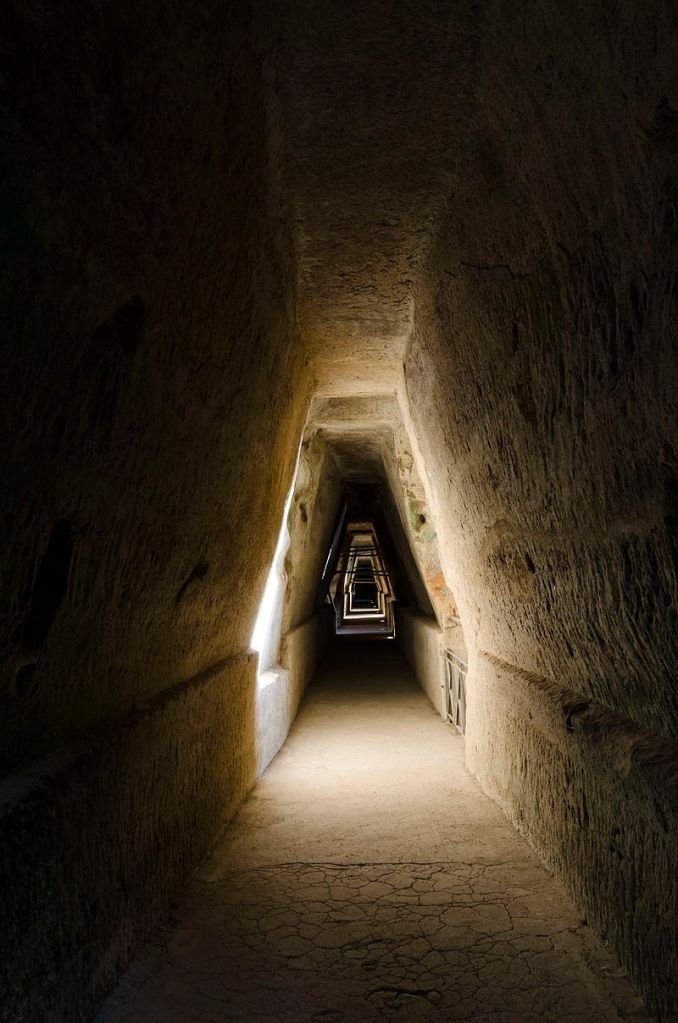
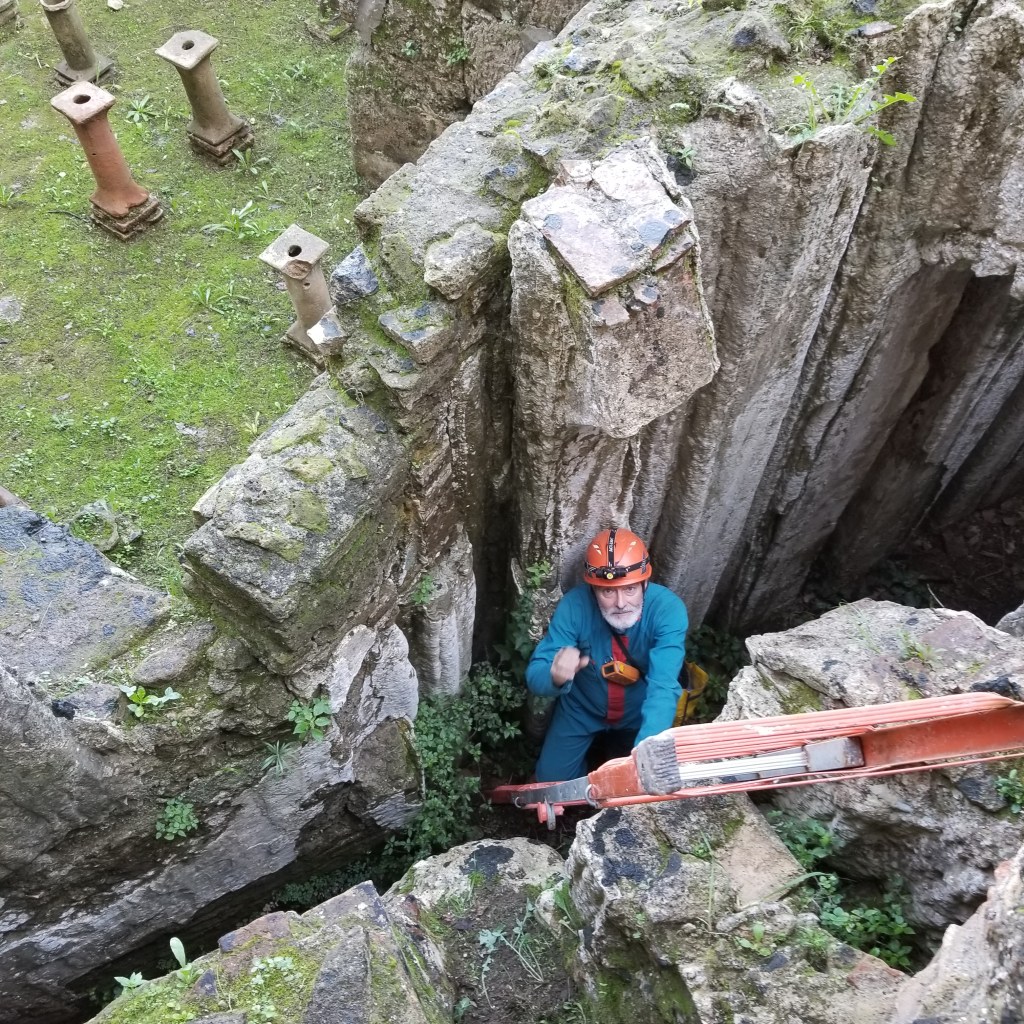
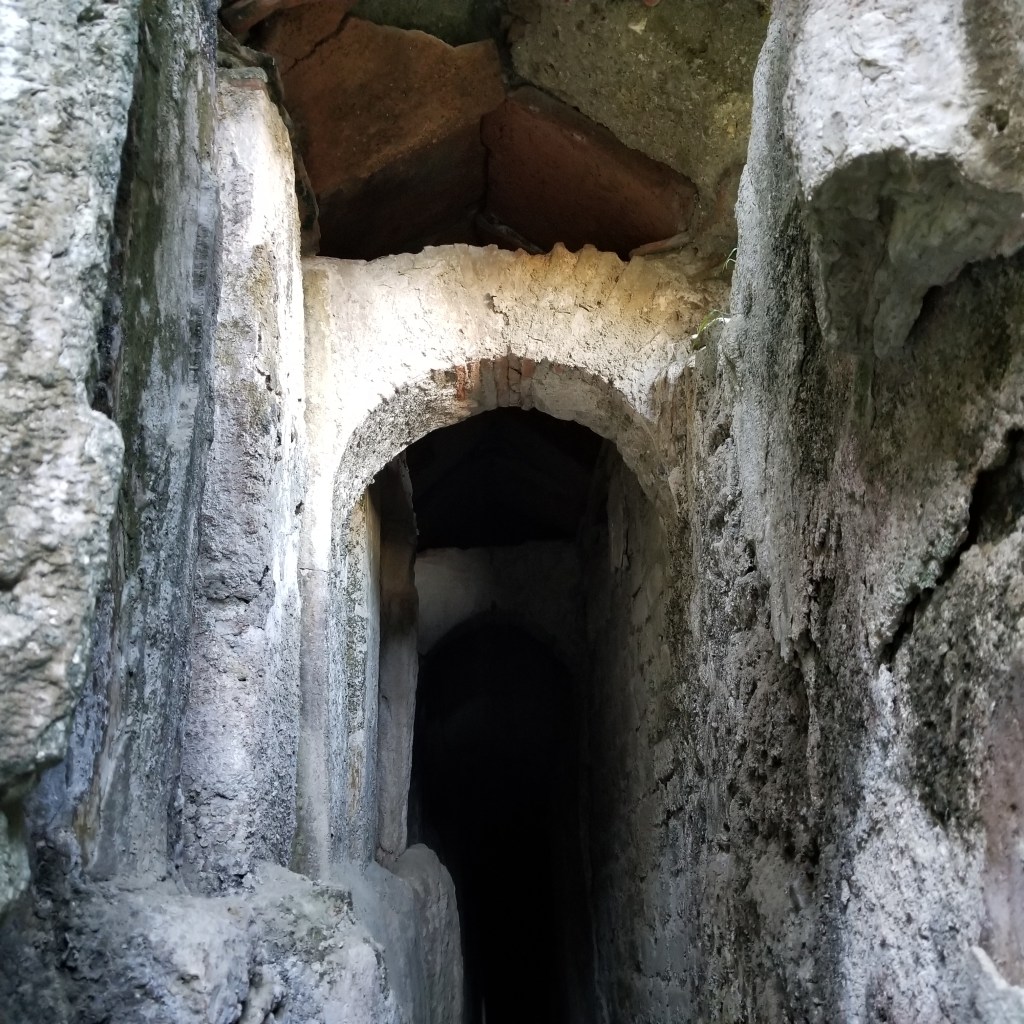
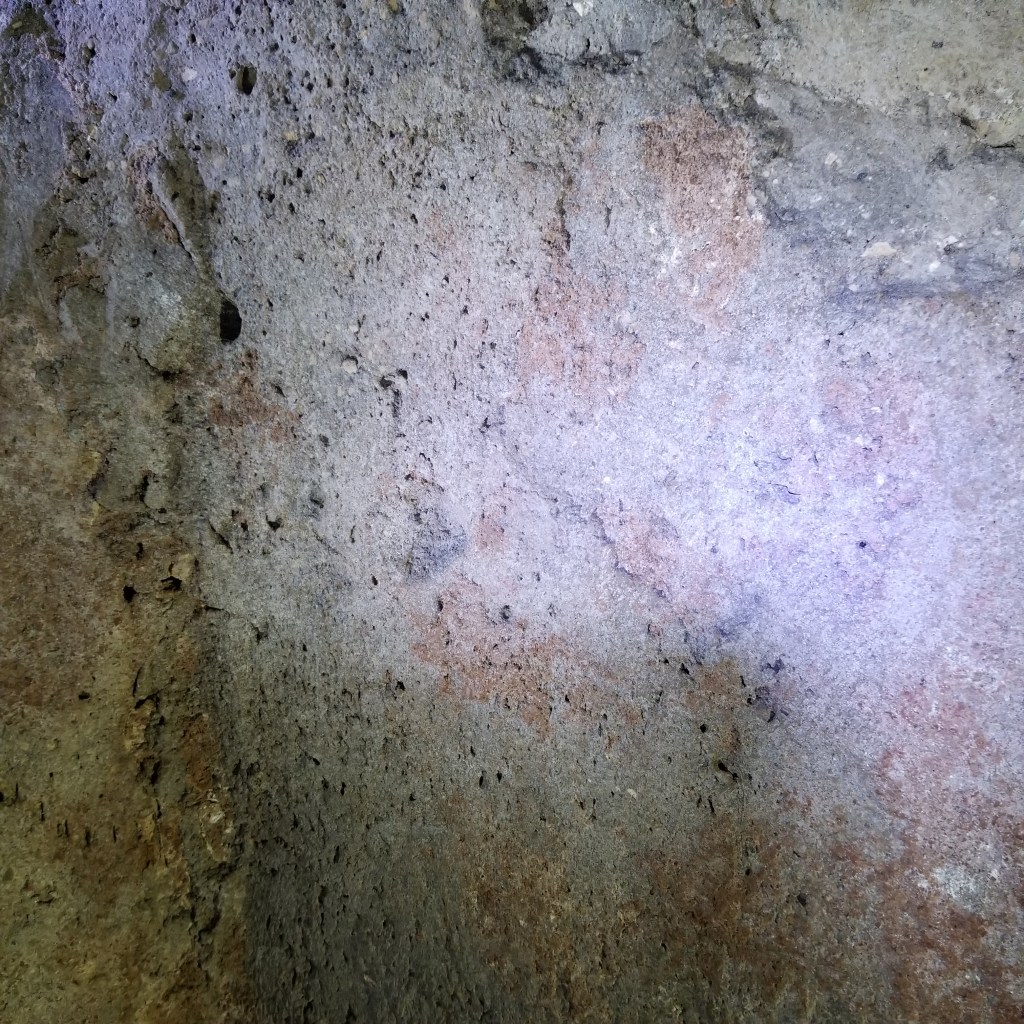
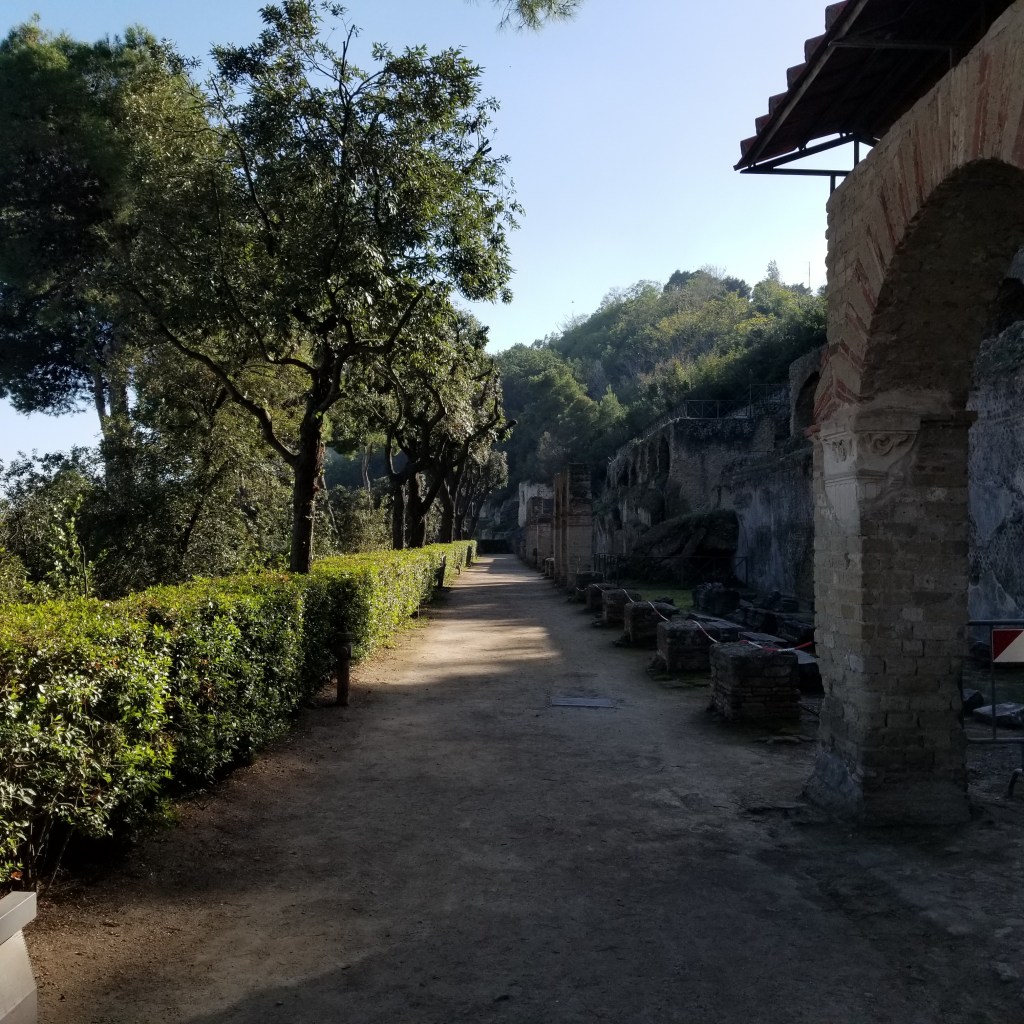
The entrance to the tunnel system is located on the left side of the Baia Thermal complex, and its original entrance is now buried. A ladder must be used to enter through the dilapidated tunnel ceiling. The walls beneath it are covered with white sinter, which likely originated from the ancient Romans allowing cold water from an aqueduct to flow along the antrum into the tunnel to produce steam. It can be assumed that the tunnel and the water inside it were boiling hot. Horizontal ditches on the tunnel wall support this theory and appear to have conducted steam, perhaps with the help of lead or terracotta pipes
See here a video of the interior of the tunnel.
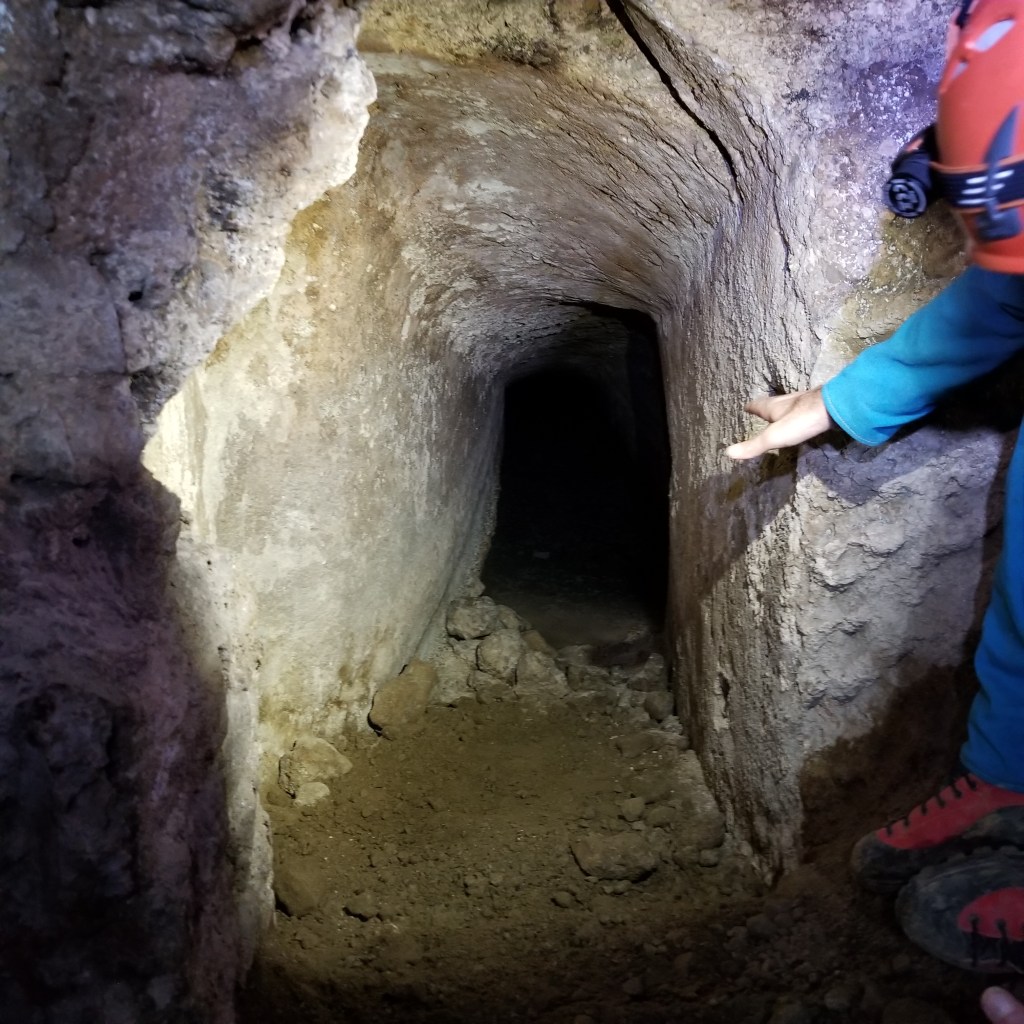
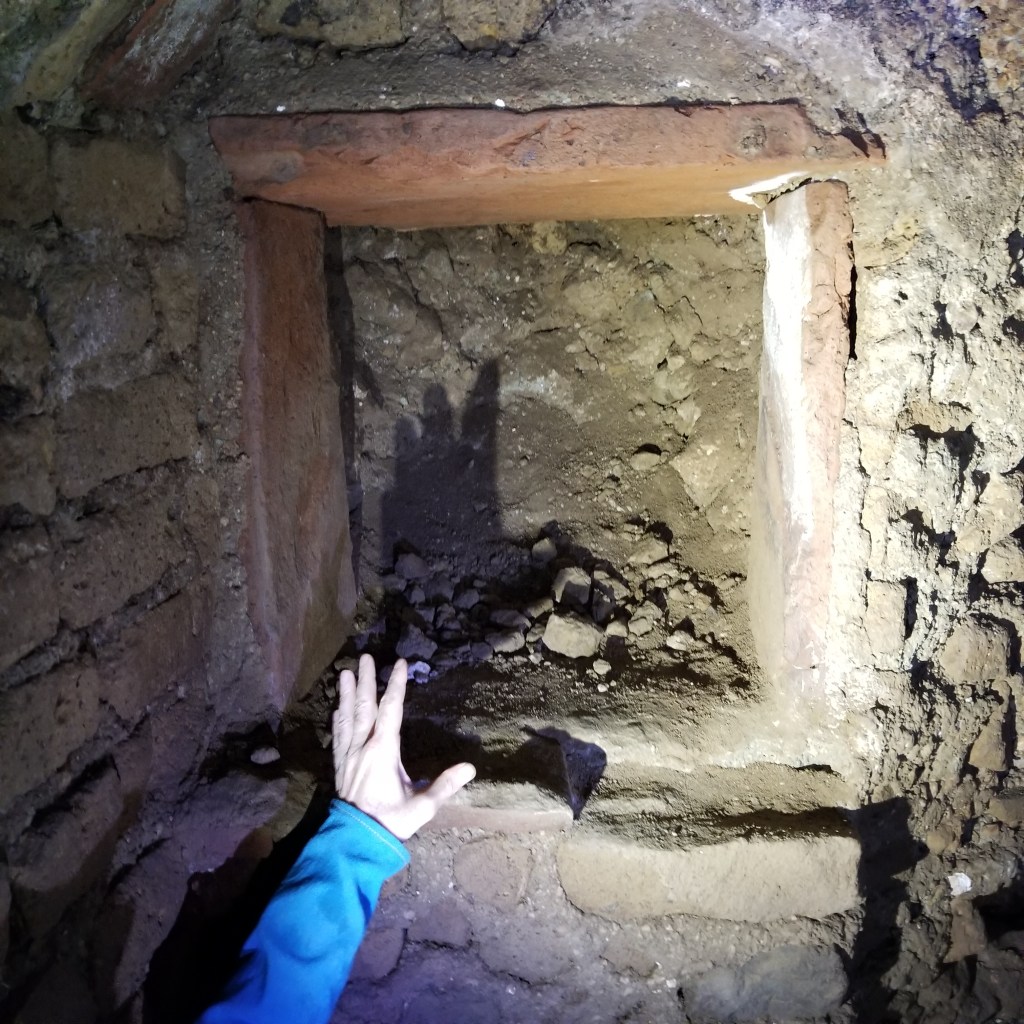
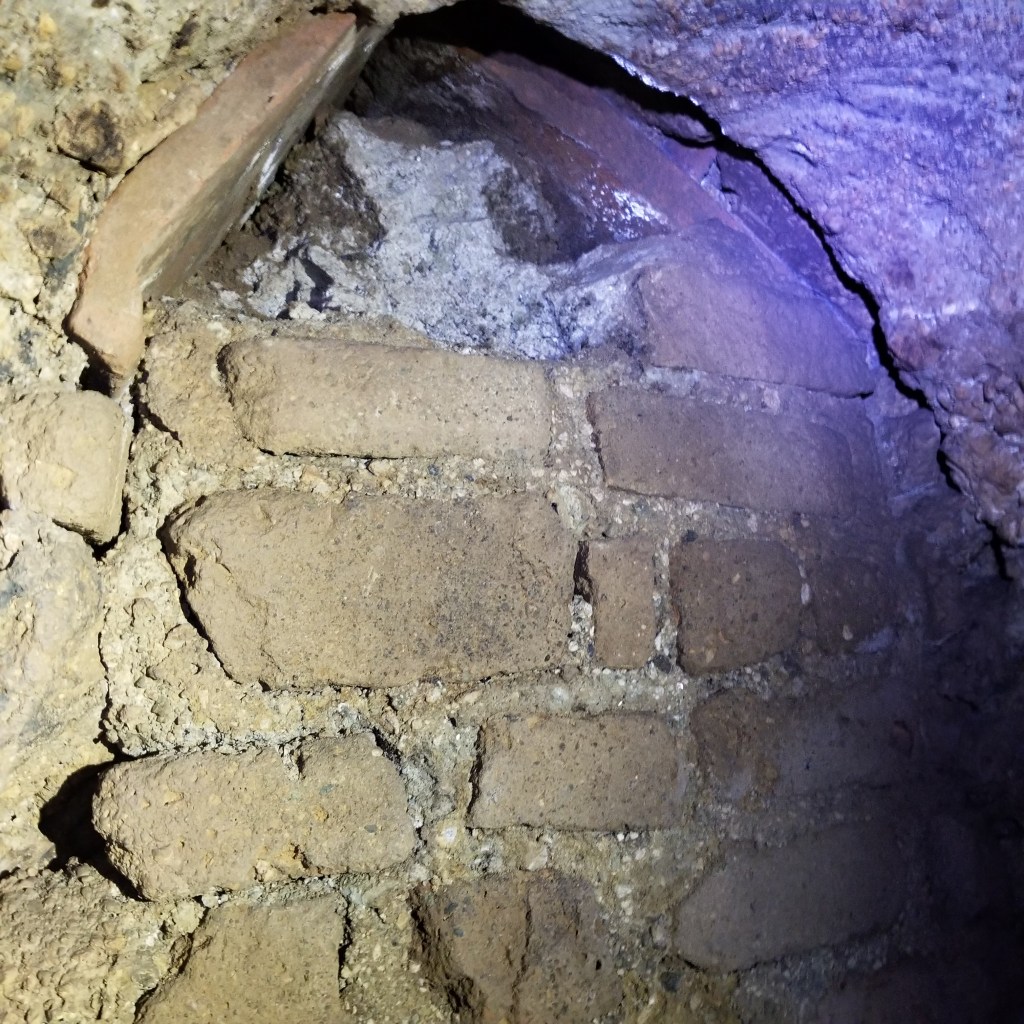
Behind the tunnel entrance, one enters a gently sloping passage that is a little over half a meter wide and described by the excavator of the Antrum, the British Paget, as “walkable.” However, the original height must have been much greater than necessary for the passage, about 2.5 meters. Wide, thick terracotta tiles support the ceiling. At the beginning, niches for lamps are set into the walls of this passage every 2 to 3 meters on both sides. When the tunnel becomes steeper, either descending or ascending, the niches become more numerous, suggesting that they served as a substitute for ladders. Those who passed through in the dark and on unstable ground could support themselves with their hands in the niches.
At the end of the entrance tunnel, on the left, there is a narrow outlet for steam to a thermal bath above. A little further in, there was certainly a branch-off in former times. Today, a walled wall closes off a side tunnel. This left tunnel, closed at the front, runs in the same direction as the entrance tunnel, which makes its purpose unclear. It can be entered by crawling from its rear end.
The main passage leads steeply downwards from this point and measures another 50 meters to the water. At its end, the tunnel goes straight down and is flooded. This flooding comes from the fact that the tunnel has sunk 3 meters due to the bradiseism of the area. The water is clear and warm to the touch. All indications point to it having once been boiling hot. Sinter deposits float on its surface. An investigation with a remote operated vehicle has shown that the tunnel is at least another hundred meters longer underwater. Directly above the site of the flooding is a kind of brick chimney that connects the lower tunnel with an upper tunnel above it. What this connection was for is unclear.
From the edge of the water, there is a passage on the right that leads steeply upwards in a zigzag. Its floor is covered with unstable sand. At its upper end, one reaches a walling which Paget tried to dig around. Due to this, a buried tunnel goes into the wall to the right of it. From this point, there is another passage that supposedly leads to the opposite side of the flooded passage. However, it is now buried and not accessible.
Paget thought that there was an ancient underworld temple behind the wall. There is no conclusive evidence for this supposition. It may simply be a retaining wall to prevent a tunnel collapse. However, thick terracotta tiles can be seen supporting the ceiling behind it.
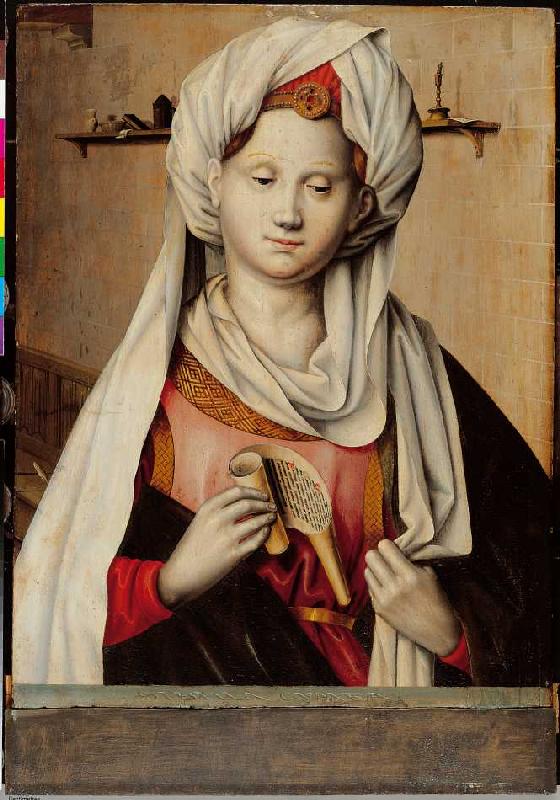
Virgil’s Sibylle of Cuma
In Virgil’s famous epic, the Aeneid, a journey to the underworld is described, which may or may not be significant in understanding the Antrum tunnel. What is certain is that it inspired the tunnel’s discoverer, Paget.
Legend has it that Aeneas, the legendary progenitor of Rome and son of Venus, was guided on a journey through the land of the dead by the prophetess of Cuma, Sibylle. This journey later inspired Dante in his description of Hell in the Divine Comedy, in which he too descends to the underworld guided by Virgil.
In Book VI of the Aeneid, Aeneas makes a journey to the Temple of Apollo in Cuma to question the Sibylle. From the temple, he descends into the Sibyl’s Antrum. The Sibyl recommends a journey to the underworld, and Aeneas meets her on the shore of Lake Averno. After making sacrifices, they descend into the entrance of a huge cave. In the outside world, the sun rises, but in hell, it is eternal night. Aeneas wanders through groves of trees, grassy meadows, and valleys. All of Virgil’s images are of vast expanses and vast multitudes of shadows of the dead. Aeneas follows the Sibyl across several rivers of hell, crosses the River Styx with Charon the boatman, encounters the three-headed dog Cerberus, and finally reaches a fork in the road. The right path leads to Elysium, the left to Hades. Aeneas and the Sibyl take the right path to Elysium, where the hero meets the shadow of his father. After this encounter, they are faced with two exits, which are also mentioned in Homer’s Odyssey. One gate is made of horn, through which the dead send true dreams to the living. The other gate is made of ivory. Through this one, the dead send false dreams. Aeneas’ dead father sends him home through the second gate.
Paget’s investigation and interpretation
The discovery and excavation of the Baia tunnel were led by the British amateur archaeologist Paget. Throughout much of the 1960s, Paget and his team excavated the tunnels, trying to understand the purpose of this elaborate underground structure.
Paget believed that much of the route matched Virgil’s description of Aeneas’ journey to the underworld. The initiate would descend a long tunnel that would eventually lead to the bank of an underground river. There, Paget speculated, a small boat would be waiting to take the initiate across the Styx. On the other side of the river, the initiate would ascend a winding path to a large room where he would meet a theatrically depicted shadow of a beloved dead person. After the conversation, the initiate would be confronted with two corridors. The left one descends steeply, and the right, which leads to the exit, gently leads back to the upper world. The Styx may only be crossed once, just as Aeneas crossed it only once.
It has also been speculated that Virgil was referring to a tunnel that existed in reality in his description. The area around Naples, which was heavily influenced by Greek culture, still celebrated the secret Eleusian cults at that time, and in all probability, in their Orpheus-inspired form of Orphism. Orpheus was not only the gifted singer he is mostly known as today, but he was also a Dionysus priest. Even today, the panther of the god Dionysus can be found depicted on the Greek tombs of Naples. The cult celebrated the descent of the goddess Demeter into Hades to find her daughter Persephone and her child Dionysus. Drugs, vapors, and underground rites probably played a role in these cults.
The tunnel in Baia – heating or ritual catabasis?
Based on archaeological findings linking the tunnel in Baia with the thermal baths, it can be assumed that its purpose was to heat the Roman thermal baths. It helped to conduct hot vapours under the floor of the baths. It is uncertain whether the tunnel served a religious purpose before or at the same time. There is no conclusive evidence of inscriptions or sculptures. Even Paget’s arguments can be refuted. The tunnel’s orientation towards the rising sun may have resulted from the builders following a natural crevice. The niches in the walls need not have been intended for festive lighting but may have been some form of hand ladder. The fact that one of the tunnels leads to the other side of the water does not necessarily mean that a boat once crossed it. It is more likely that the tunnel was not flooded in the past, and the ground only lowered later.

Yet, the mystery of the massive stone blocks around the entrance to the tunnel remains. The Roman baths were built with brick, while the temples of nearby Cuma were built of massive tuff blocks, which are the same as those used at the tunnel in Baia, the ancient Aquae Cumane. Therefore, it cannot be ruled out that the tunnel once served to supply vapours to an Apollo oracle of Sibylle. A similar structure has been found at Delphi. However, more research is needed to confirm this theory.
Read more in “The City of Ghosts”.
U.C. Ringuer
 Archaeology Mysteries