The query for the whereabouts of the Philosopher’s Stone might strike one as bizarre, or better sensationalist. Yet, the question leads the author of a new book to a profoundly real and venerable figure, as well as on a journey through theology, alchemy, and to an Abbey in Italy. The man in question is esteemed as both the greatest Christian thinker of the Middle Ages and as a possible guardian of the ancient alchemical secret of the stone: Thomas Aquinas.
The Proof of God—and an Alchemist?
Thomas Aquinas, Saint, theologian, philosopher. In the 13th century, he authored his monumental work, the Summa Theologiae, outlining his famed five ways to prove the existence of God. He demonstrated that reason and faith need not be contradictory but can complement each other. However, some of his texts—particularly private notes and mystically inclined letters—cast also a rather unusual shadow on the rational scholar: hints of alchemical studies, even of a certain substance purportedly in his possession—the said legendary Philosopher’s Stone.
The Philosopher’s Stone—Myth or Reality?
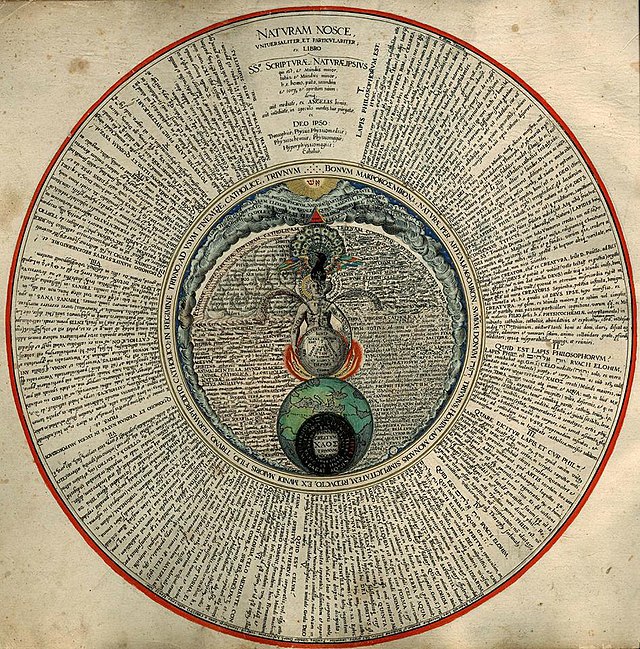
The Philosopher’s Stone is not merely an alchemical curiosity; it is revered as the Holy Grail of Hermeticism, even though it is uncertain what it truly entails. It is said to be a substance that can transmute base metals into gold and—perhaps even more significantly—bestow eternal life. Many considered it pure fiction. Yet Thomas, a man of reason, is reputed to have truly possessed it.
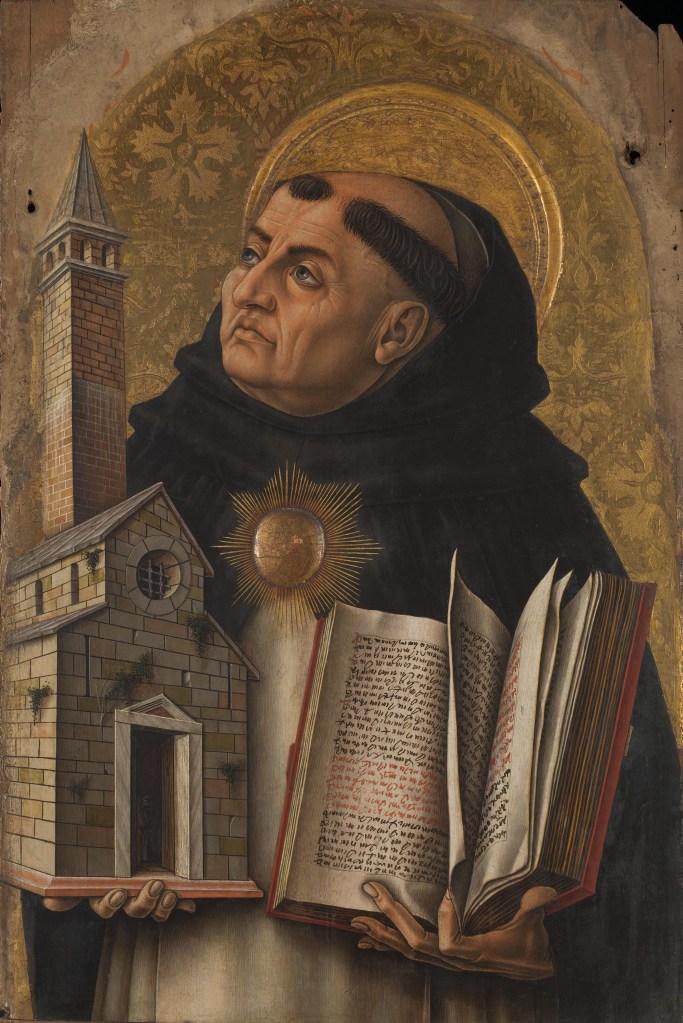
Certain accounts from the Dominican Order suggest that in the latter years of his life, he wrote not only about God but also about the ultimate transformation of matter, about the “perfect substance”, which he supposedly obtained from Albertus Magnus, another one of the church’s great.
Admitting this proclivity for Alchemy was in the later centuries understandably unwelcome. How can one reliably prove God and dabble in sorcery simultaneously?
The new book—”The Proof of God“—now delves deeper into the matter, not merely as a thrilling narrative replete with murder and pursuit but also as a very tangible scientific investigation. And what the author has uncovered is undeniable. The Philosopher’s Stone may indeed have existed—yet it might have been something entirely different from what is commonly believed. Basically laying in plain sight.
Curious?
We give you a hint: What would a saint do with an object that—allegedly—grants power, wealth, and immortality? Precisely: he would ask for none of those.
It is said that Thomas never used the Stone—at least not for himself. Instead, he withdrew, kept silent about his achievements, and spent his final days in the Abbey of Fossanova, a secluded place south of Rome, where he passed away on March 7, 1274—or rather, he vanished from the world of those who sought to understand.
A Peculiar Mosaic
Today, visitors to the Abbey of Fossanova are greeted by a very curious mosaic over the main gate. It displays not a traditional Christian motif but a symbolic decoration. Beneath it, reportedly, lies a mystic inscription.
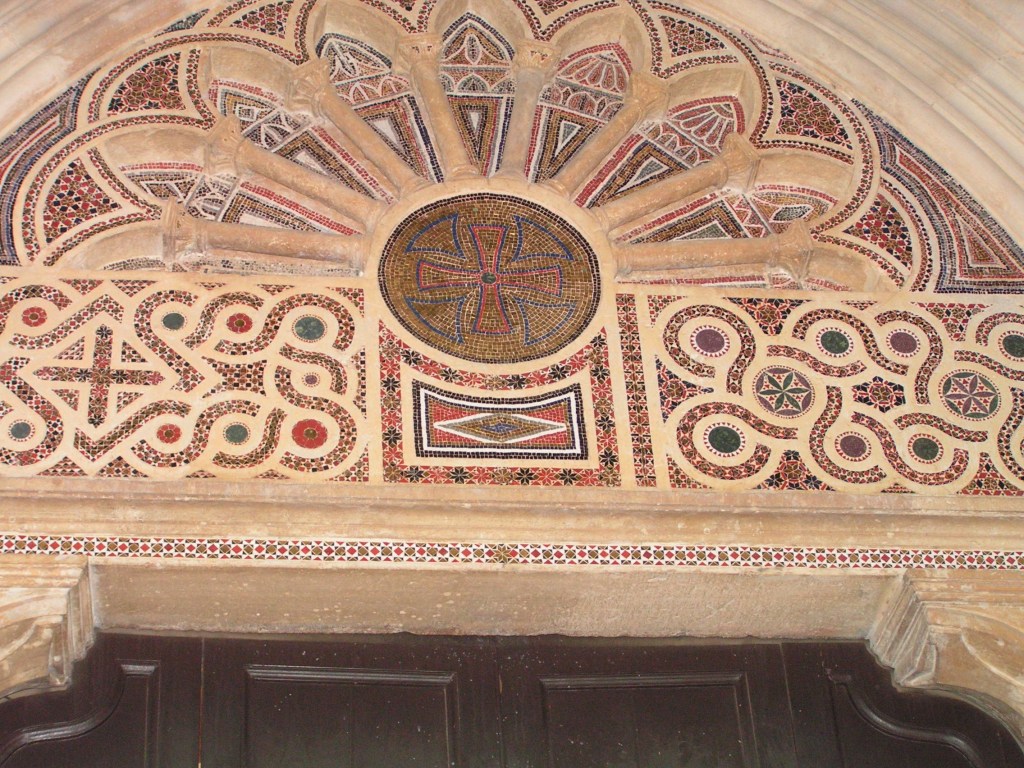
Could the Philosopher’s Stone be hidden there? In the mosaic or under it? Or in Aquinas’s death chamber? Somewhere in Fossanova?
Mosaic in Fossanova Abbey
The book “The Proof of God” offers a —naturally fictional— answer. But the solution of what the Philosopher’s Stone might actually have been and where it might have come from is not invented. And it is indeed quite compelling. Honestly—it’s astonishingly compelling.
Ringuer uses the facts around the stone to lead us not only to traces and hints in history, but also to very concrete religious considerations. In the sort of: Are God and the Big Bang really so different?
Until we reach the answer, the narrative of “The Proof of God” remains thrilling. In a swift narrative style, Ringuer takes us to the dark Abbey of Fossanova, amidst tormented monks and fierce storms, facts and fiction.
Readers will be delighted. Suspense guaranteed.
 Archaeology Mysteries
Leave a comment