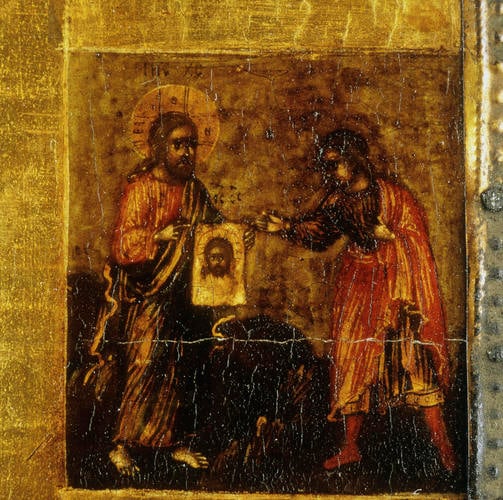
On August 15, 944, the feast day of the Dormition of Our Lady, Constantinople celebrated as one of the most precious relics of Christianity, the famous Mandylion with the imprint of Christ’s face, was brought to the city from Edessa (now Urfa in Turkey). The relic was transferred to the Hagia Sophia the following day and eventually found its repository in the famous chapel of the imperial palace, the Pharos Chapel of the Bukoleon, which is now lost.
An annual commemoration of the transfer of the image was included in the Orthodox liturgical calendar for August 16, which to this day is celebrated as the feast of the translation of the ‘image not made by man’.
However, what became of the relic remains a mystery.
What is the Mandylion about?
According to Christian Orthodox tradition, the image of Edessa was a sacred relic consisting of a rectangular cloth on which a miraculous image of the face of Jesus had been imprinted. The Savior is said to have wiped his sweat-covered face with it, and in the process God is said to have burned his image into the textile.
The so-called mandylion (from Greek μανδύλιον “cloth, towel”) was thus understood as the first icon and original image of the Savior. In Eastern Orthodoxy it is also called an acheiropoeiton, a ‘non-man-made image’. This definition of ‘not man-made’ was important in the Byzantine image controversy, which was about whether the divine nature of the Savior could be depicted. If God had created the Mandylion, it was said, the answer to the question was yes.
The story of the Mandylion is similar to that of the Shroud of Veronica and is intermingled with it in the Western world. Some interpretations think that Veronica is just a verbalization of the word ‘true icon’ (Latin ‘vera’, ‘the true’ and Greek ‘eikon’, the image) and both cloths are identical.
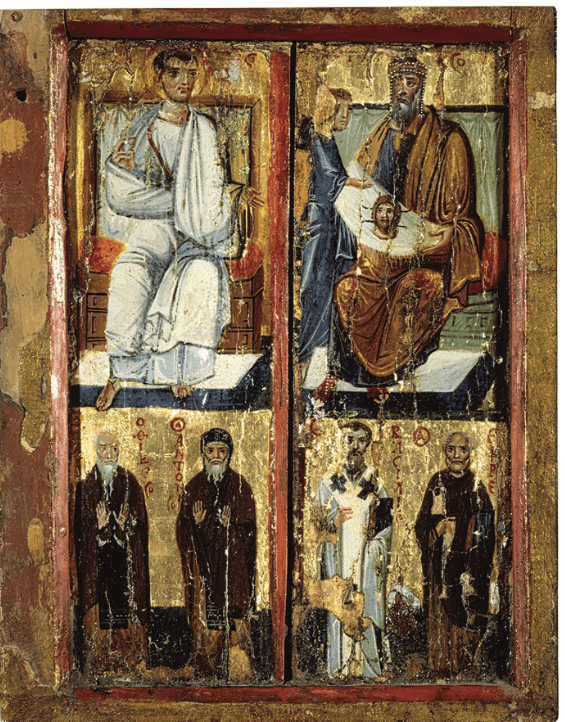
The Mandylion was depicted shortly after its arrival in Constantinople on an icon that is still preserved in the Monastery of St. Catherine on Mount Sinai. It is divided into four panels: In the top right panel, King Abgar is seated, holding the Mandylion with the face of Christ visible to the viewer. To the left is a smaller figure making a pointing gesture. This figure is probably Hannan, Abgar’s messenger, who delivered a letter from the king to Christ in Jerusalem and received the Mandylion in return. On the upper left panel, there is another seated figure, dressed in white and alone. That figure is Addai (or Thaddeus in the Greek tradition), the apostle of Edessa. On the lower panels, there are two pairs of standing saints: on the left, St. Paul of Thebes and St. Anthony; on the right, St. Basil and St. Ephrem.
Where did the Mandylion come from?
The Mandylion made its appearance on the great world stage at the moment of its entry into Constantinople. At the beginning of 944, the Byzantine Emperor Romanos I had reached an agreement with the Muslim rulers of besieged Edessa that they would hand over the Mandylion to the commander John Kurkuas in exchange for 200 Muslim prisoners and 12,000 pieces of silver. However, it did not come into the hands of the Byzantines alone, but was accompanied by 3 copies and the Keramidion, a god-made copy of the Mandylion imprinted on a roof tile (the Mandylion had been hidden on a roof for a while).
However, the year 944 was not the moment of origin of the legend of the cloth, which turns out to be much older:
Already a tradition of Eusebius of Caesarea in his Church History from the early 4th century describes how King Abgar of Edessa had asked Jesus to come to him and heal him from an illness. From a later extension of the story, one can surmise that it may have been leprosy. This is not certain, and it may be a later interpretation, since leprosy did not become a problem in the Byzantine Empire until the 3rd century.
Abgar V did indeed exist. He also called himself Ukkāmā which means “the black one” in Syriac and other Aramaic dialects. He was the Arabic-born king of Osrhoene, with Edessa as its capital (c. 1st century BC – c. AD 50).
Abgar allegedly received a reply letter from Jesus in which he declined the invitation to Edessa but promised a visit by one of his disciples. One of the seventy disciples, Addai or Thaddeus of Edessa, is said to have subsequently come to Edessa and delivered a letter from Jesus, by which the king was miraculously healed.
The letter is said to have been preserved, and Eusebius claims to have copied and translated it in the Syriac chancery documents of the king of Edessa. However, he does not mention an effigy.
An effigy is first mentioned in a Syriac work, the Doctrine of Addai. According to it, the messenger of Abgar, here called Ananias, was also a painter, and painted the portrait, which was brought back to Edessa and kept in the royal palace.
The first report of the existence of a god-made image that was supposed to have been in the ancient city of Edessa then comes from Evagrios Scholastikos, who around 593 mentions an image of Christ of divine origin (θεότευκτος), which in 544 is said to have provided miraculous help as a palladium in the defense of Edessa against the Persians.
Eusebius makes no mention of the fate of the Edessa letter. However, since it was likely made of papyrus, it would have decayed over time. Papyrus typically had a lifespan of only 100 to 200 years in ancient libraries. What is remarkable, however, is the transformation of the revered object from a letter to a hand-painted image and then to a God-made cloth. The Mandylion subsequently disappeared, was thrown into a well, which became miraculous, and reappeared. Copies of the cloth were made, leading to falsification. The path of the cloth was bumpy.
It is not surprising, therefore, that during the siege of Edessa, the Byzantines demanded all copies of the cloth. It seems that even at that time, it was not entirely clear which cloth or picture was the genuine one.
It should also be noted that there is a strong tradition of the miracle tree around ancient Edessa, on which cloths are hung to fulfill wishes. Such a tree still stands today in nearby Göbekli Tepe. A leap from a letter to a cloth would therefore be in line with this tradition. It might be theorized that the tree is an ancient trace of a ritual personification of the goddess Ashera.



Wishing trees with cloths like these still serve as “wish mediators” in Turkey and also close to ancient Edessa (Urfa).
In addition, it is not the number of three that is worshipped in the area, but the number five. Still today one worships the five-fingered hand of Fatme (Hamsa) or damns enemies in using the number five. Five relics would meet this condition for holiness as a collection (Mandylion, Keramidion and three copies).
What became of the Mandylion?
The Mandylion, together with the Keramidion, remained in the Pharos-Chapel in Constantinople in golden shrines suspended from the ceiling until 1204, when the crusaders of the Fourth Crusade sacked the city. Its further fate (and that of its copies) leaves room for speculation. There are several versions and candidates:
The cloth of the Sainte-Chapelle in Paris
After Constantinople was sacked, the new Latin imperial house had to sell the Passion relics accumulated in the previous two centuries to balance its treasury. France acquired them from the Venetians for an astronomically high sum after Baldwin II had pawned them and could not redeem them.
The relics, totaling twenty-two, were originally located in Constantinople’s Bucoleon Palace and the Blachernae Church. They were brought to Paris in three separate voyages: first, the famous Crown of Thorns, which left Constantinople in 1239; then, a group of several relics, which may have included the Mandylion, which arrived in Paris in 1241; and finally, a smaller group of relics that left Constantinople in 1241 and arrived in Paris in 1241 or 1242.
The Crown of Thorns, parts of the Cross, the Blood of Christ, the Head of John the Baptist, and many other relics were kept in a large chest, the Grande Châsse, in the Sainte-Chapelle from then on.
One of the relics is described as “sanctam toellam, tabulae insertam.” However, it is uncertain whether this was truly the Mandylion.
First, it should be noted that the Mandylion was unknown in the West and was thus described in vague terms when it arrived at the Sainte-Chapelle. It was not referred to in inventories as the Mandylion or Image of Edessa, but rather as a “sacred cloth.”
What came to Paris was kept in the chest containing all the other relics, the Grande Châsse, elevated on a platform behind the altar under a canopy. All the reliquaries were behind closed doors, which were locked with ten different keys. So was the cloth.
Most of the relics and reliquaries were then lost during the French Revolution. Only three of the relics remain today: the Crown of Thorns, the Nails of the Passion and a piece of the True Cross, which were first kept in the treasury in Notre-Dame, but after its fire went to the Louvre. The Sainte-Chapelle no longer houses relics or reliquaries.
The question is whether the Mandylion arrived in Paris and, if so, what became of it.
The theory circulating is that it arrived in Paris and was given by King Philippe VI of Valois to Geoffroy de Charny as a gift for his great services to France, and was therefore identical to the Shroud of Turin. However, this is not credible, since pilgrims had previously described seeing both, Mandylion and shroud in Byzantium. Moreover, the first inventory, i.e., a list given by Balwin II to Saint Louis, mentions both the words ‘sanctam toellam, tabulae insertam’ (a sacred cloth) and ‘partem sudarii quo involutum fuit corpus ejus in sepulchro’ (a part of the burial shroud of Jesus). The last inventory in Morand’s book, dated July 1, 1790, continues to mention both separately.
Yet, an inventory of the Sainte-Chapelle, made on March 22, 1534, on the occasion of a theft, certainly confirms a fundamental doubt about the identity of the textile:
Et au regard du huitième article, contenant la trelle inserée à la table, après plusieurs difficultés, a esté finallement trouvée en un grand reliquaire et tableau garny d’argent surdoré, où y a apparence d’une effigie, ladite trelle comme consommée contre ledit tableau, autour, environ et dans ladite effigie.
And regarding the eighth article, which contains the image inserted in the grid, so after several difficulties it was finally found in a large reliquary and a tablet covered with gilded silver, in which there is an effigy, the grid being consumed with and around the image.
Inventory of 22 March 1534
The officials were probably searching for a cloth, but none was found in the reliquary. After several attempts to locate it in the reliquaries, the officials concluded that what had previously been referred to as a cloth (“toile”) must instead be a “trelle” (treillis), a grate or one of the typical icon metals (Russian ‘riza’), and thus a misspelling. Therefore, the officials would have intended to write “trelle” instead of “toile”.
In the text of all subsequent inventories, the words “trelle” (grid) and “toile” (cloth) are no longer used, as this description was too complicated to express the obvious directly: There was an image of the face of Jesus Christ on the floor of the reliquary. The terms “Veronica” and “Holy Face” are preferred to describe it succinctly.
One can draw three possible conclusions:
- The Mandylion never came to Paris, but only an image, i.e. most likely one of the three copies; or
- The Mandylion was made of a fabric or painted with something that melted or stuck to the substrate or bonded to the metal placed over it (resin?). This would be supported by the description of the fusion (‘consommé) as well as the preceding formation of the Keramidion; or
- The Mandylion was taken out of the reliquary after its arrival, stolen or given away. What remained was the empty shrine with an image of the original contents.
According to all of this, it is possible that the Mandylion came to Paris and was destroyed during the French Revolution. However, given the little attention paid to the relic since its arrival in Paris, it is more likely that the original cloth never reached the city and that it was only one of the three copies from Edessa. In Morand’s picture, the reliquary of the Mandylion is seen as a flat box on which they have placed, quite unceremoniously, the cross with the part of the lance that touched Christ.
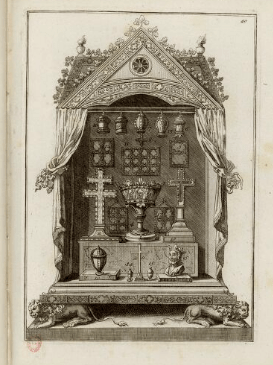
Illustration: an 18th century artistic replica of the Grande Châsse containing twenty relics, eighteen of which are from Constantinople. Two relics of the Virgin Mary were added and three relics from Constantinople were placed in the basement of the Sainte-Chapelle.
Many Byzantine reliquaries were replaced with new ones, but not the reliquary of the Mandylion and the reliquary of the piece of stone from the tomb of Jesus Christ. Here is the engraving from Morand’s book. The last presentation of the Châsse.
In the center of the image is the reliquary containing the crown of thorns, and all the reliquaries are numbered. The cloth of the washing of the feet is number 11, and the veil of the Savior is number 15. Relic 17 is a part of the sudarium that had wrapped Jesus Christ in his tomb, while 18 is the Mandylion, also known as “une sainte face” or “holy face.” This information is based on Planche de Sauveur-Jérôme Morand’s work from 1790 (p. 40).
Alternative Relics?
If the Mandylion did not make its way to Paris, then where is it?
There are several images that claim to be the true Mandylion, each surrounded by an ornate outer frame with a gilded metal sheet that has a cutout showing the face. The shape of the hair and beard are visible at the bottom of the face, and this consistent representation suggests that there was a strong tradition in Western Europe regarding the Mandylion’s appearance.
One possible alternative is the Veil of Veronica, which is housed in St. Peter’s Church in Rome.
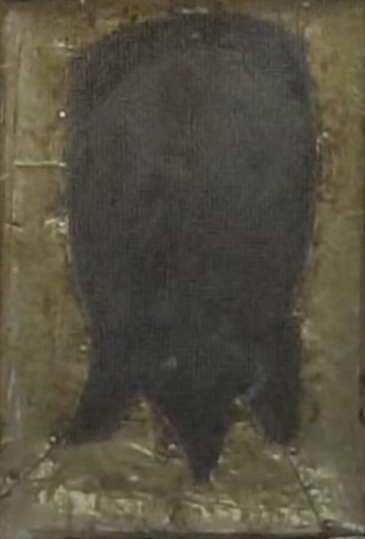
St. Peter’s Basilica houses an image that is said to be the Veil of Veronica. This image is located in the chapel situated behind the balcony of the southwest pillar that supports the dome. In 1907, the Jesuit art historian Joseph Wilpert was given permission to remove two crystal plates to examine the image. He described a square fabric that had yellowed with age and had two large, faint rusty-brown spots.
The Veil of Veronica is often assumed to have been present in the old St. Peter’s Basilica during the reign of Pope John VII (705-8), as a chapel known as the Chapel of Veronica was built during his reign. However, there is no reference to the cloth at that time. Nevertheless, it appears that the veil venerated today was present at least in 1011, when a scribe was identified as the keeper of the cloth.
It is worth noting that the image was in the Vatican at the same time that the Mandylion was still in Byzantium, so it cannot be identical to it. However, it shows the same style as all replicas of the Edessa image, with gold framing, head and beard shape, and appears to be inspired by it. There are also reports (which may be convenient) that the Edessa image was stolen from Edessa before the Byzantines obtained it, and that the real image came to Rome via Jerusalem.
The Manoppello image
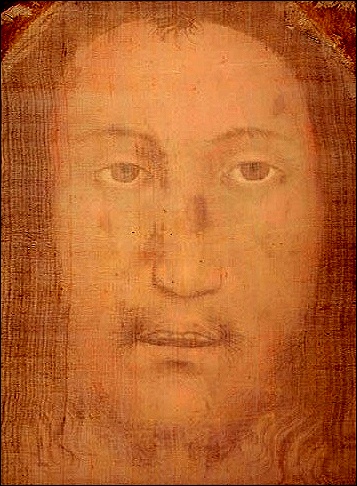
Another candidate for the Mandylion is the Manopello image found in 1999 by German Jesuit Father Heinrich Pfeiffer, professor of art history at the Pontifical Gregorian University. He announced at a press conference in Rome that he had found the Veil of Veronica in a church of a Capuchin monastery in the small village of Manoppello in Italy, where it had been since 1660.
He claimed that it was the real Vatican Veronica, which had been stolen from there. Verification has shown that it is a monochrome late Gothic brush drawing on gauze-like linen. It is probably a Dutch-influenced German work executed around 1500.
Holy Face of San Silvestro, Vatican
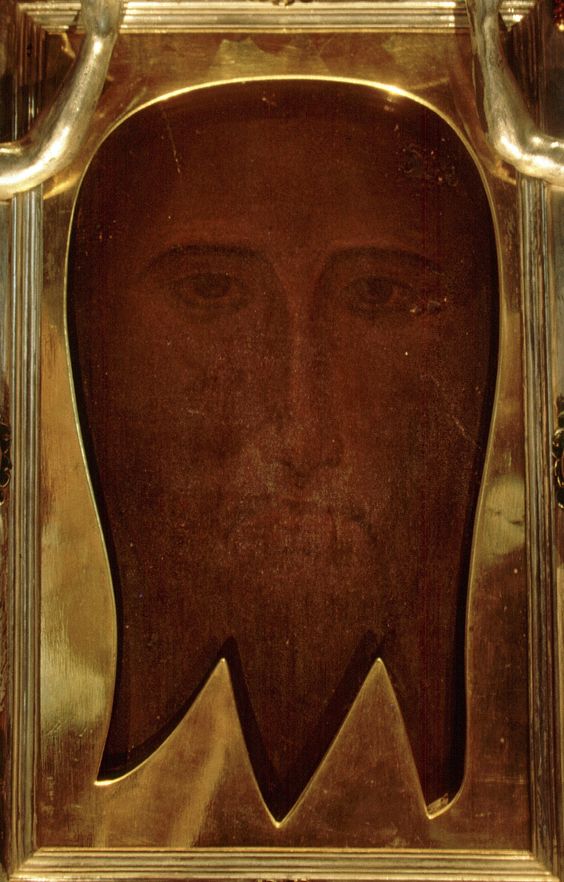
The Holy Face of San Silvestro was kept in the Roman church of San Silvestro until 1870 and is now located in the Matilda Chapel in the Vatican. It is housed in a Baroque frame that was donated by Sister Dionora Chiarucci in 1623. The earliest known evidence of its existence dates back to 1517, when nuns were forbidden to display it to avoid competition with the Veronica. It is painted on cardboard and, therefore, is almost certainly a copy.
Holy Face of Genoa
The most interesting painting is the Holy Face of Genoa, kept in the modest church of St. Bartholomew the Armenian in Genoa.
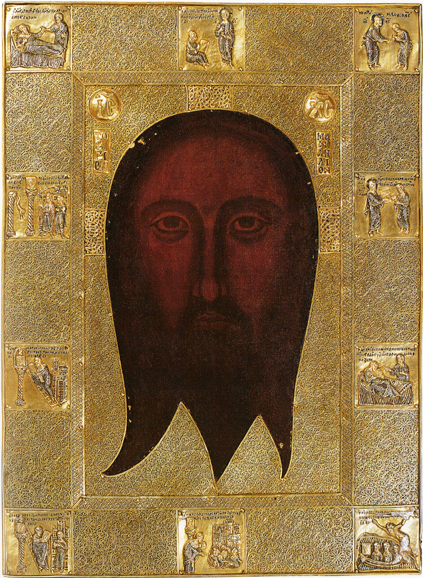
It was given to Doge Leonardo Montaldo in the 14th century by the Byzantine Emperor John V Palaeologus. The painting was studied in detail in 1969 by Colette Dufour Bozzo, who dated the outer frame to the late 14th century, while the inner frame and the painting itself are thought to be earlier.
An exact dating was not possible, but it is obviously a picture painted in the Mandylion tradition. It is not excluded that it is one of the copies from Edessa. A more detailed study for dating would be necessary. However, it is certainly not the original Mandylion, which would have been too precious for the Byzantines to send as a gift to Genoa.
Conclusion:
Based on all this information, it is likely that the cloths in Paris, Rome, and Genoa are (or were) copies of the Mandylion. Their style and presentation are almost identical. However, the whereabouts of the real Mandylion, as well as the Keramidion, remain questionable.
And if the Mandylion is still in Istanbul?
Since there is a legend in Istanbul that there are relics of Christ under a column and the Bukoleon Palace is also lying unexcavated in the ground, both remain a potential source of surprises.
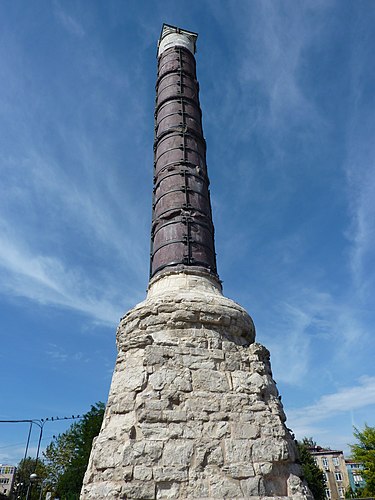
In Istanbul, there is a legend that Christ’s relics are buried beneath the Çemberlitaş Column (Constantine’s Column), and that there is even a tomb located underneath it where the body of the last Byzantine emperor, Constantine, is said to be hidden after he fell and disappeared at the Canon Gate of Theodosius’ Wall.
It is commonly thought that this legend refers to the Nails of the Passion. However, since these are proven to have come to Paris, it is possible that instead the Mandylion and Keramidion are buried under the column.
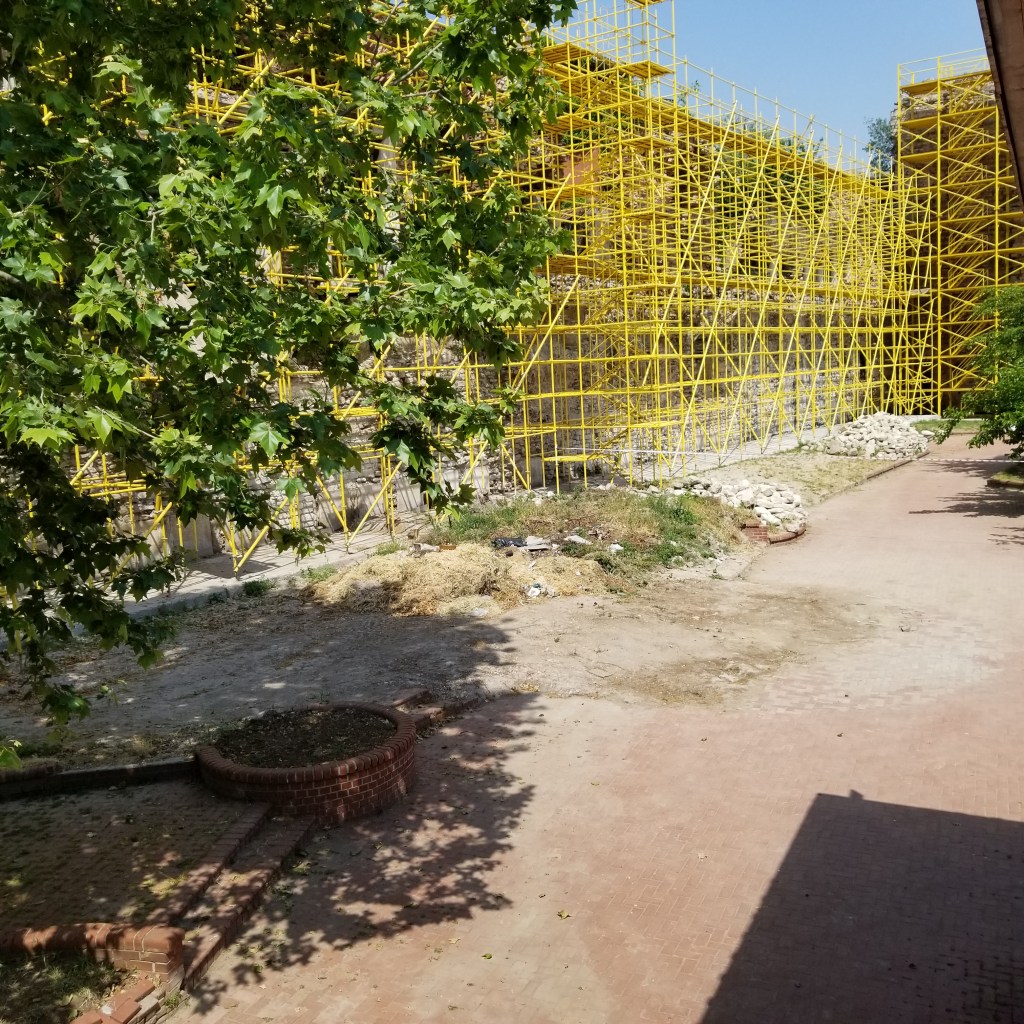
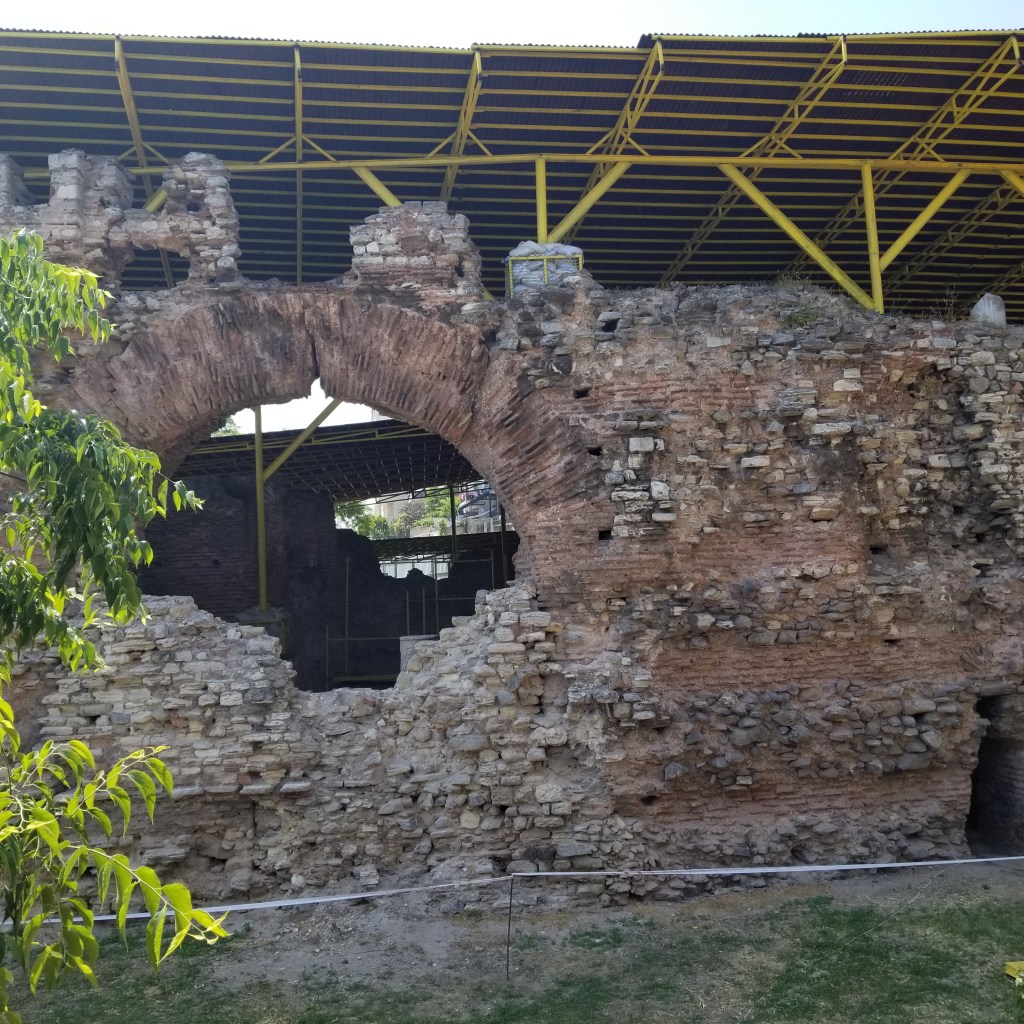
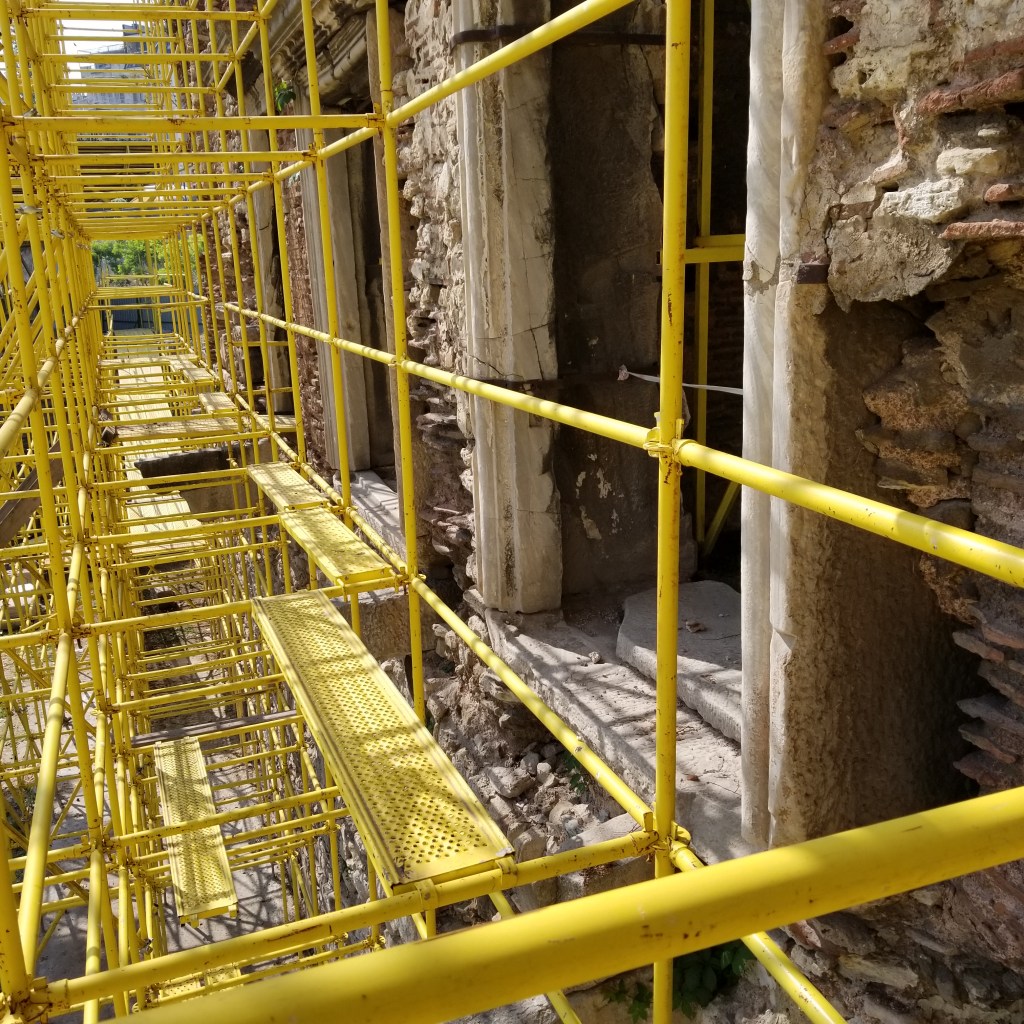
According to another legend, the relics might be in a cistern under the Bukoleon Palace. The palace facade and the rooms behind it are currently being excavated, and surprisingly, 12 skeletons have already been found. Why not relics as well? Anything is possible. The Bukoleon has never really been thoroughly investigated.
Stay tuned for updates.
 Archaeology Mysteries
Leave a comment